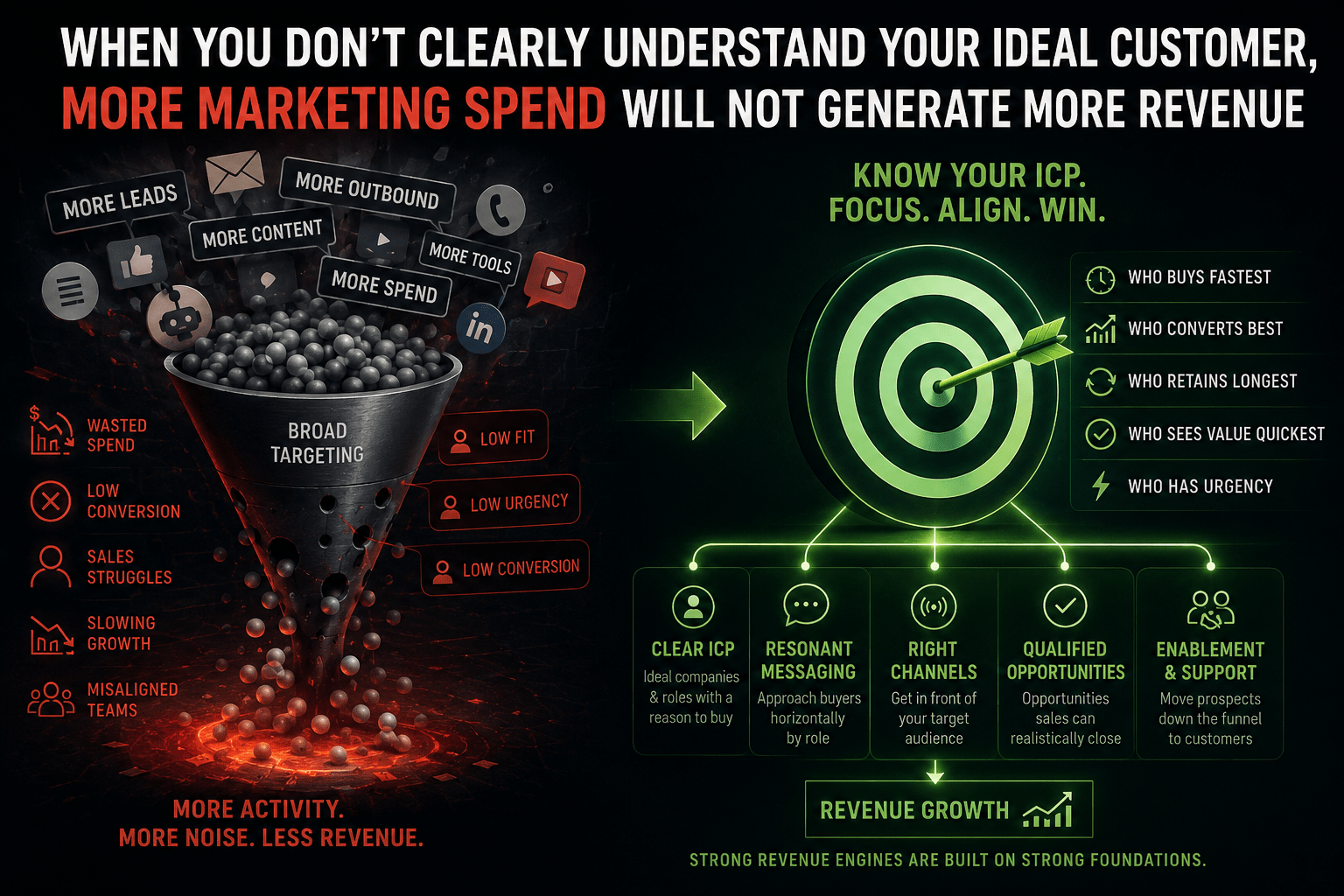
A surprising number of SaaS companies still treat ICP definition like a branding exercise, or worse, an afterthought. If sales and marketing don’t clearly understand:
- who buys fastest
- who converts best
- who retains longest
- who sees value quickest
- and who actually has urgency around the problem
Then scaling marketing activity just wastes more time, effort, and cash instead of generating more revenue.
Most GTM problems start with weak fundamentals. Eventually leadership sees slowing growth and assumes:
- We need more leads
- Let’s increase our outbound activity
- We need to create more content…we can just have AI write it for us
- More cold calls, more cold sales email, more LinkedIn outreach
So the company increases spend, adding personnel and tools while dumping more money into channels that are underperforming. And predictably, sales still struggles to add pipeline consistently, and even more disappointingly, close deals and add revenue. The underlying issue was never activity: It was targeting.
You can generate thousands of MQLs from companies that were never realistically going to buy. (please don’t tell me you’re still using a lead scoring model that sends “MQLs” to sales because they read a couple of whitepapers or visited your website)
It’s not contributing to growth, it’s just creating more noise.
Strong revenue engines are built on:
- Clear ICP definition – both the ideal type of companies and the roles at those companies that have a reason to buy your solution
- Messaging that resonates with qualified buyers – helpful messaging hint: people view the world through their own lens, so it helps to approach them horizontally by role
- Channels that get your message in front of your target audience – not just the channels that are easy to measure or cheap to run.
- Qualified opportunities that sales can realistically close. And sales enablement to help them move prospects down the funnel to becoming customers
Without that foundation, scaling GTM activity doesn’t scale revenue. It just scales inefficiency. And at some point, the board starts asking questions nobody wants to answer.
It doesn’t have to get to that point. Fix the foundation: ICP, messaging, and targeting. Everything downstream gets easier. Wait too long, and you’ll be doing it under pressure with a lot less runway.
The fix is probably closer than you think.
Start with a 90-minute Revenue Engine Diagnostic. From there, depending on what it needs, I can help build out a complete GTM foundation: SWOT, ICP, target personas, messaging, and content.
 stanbowers.com