-
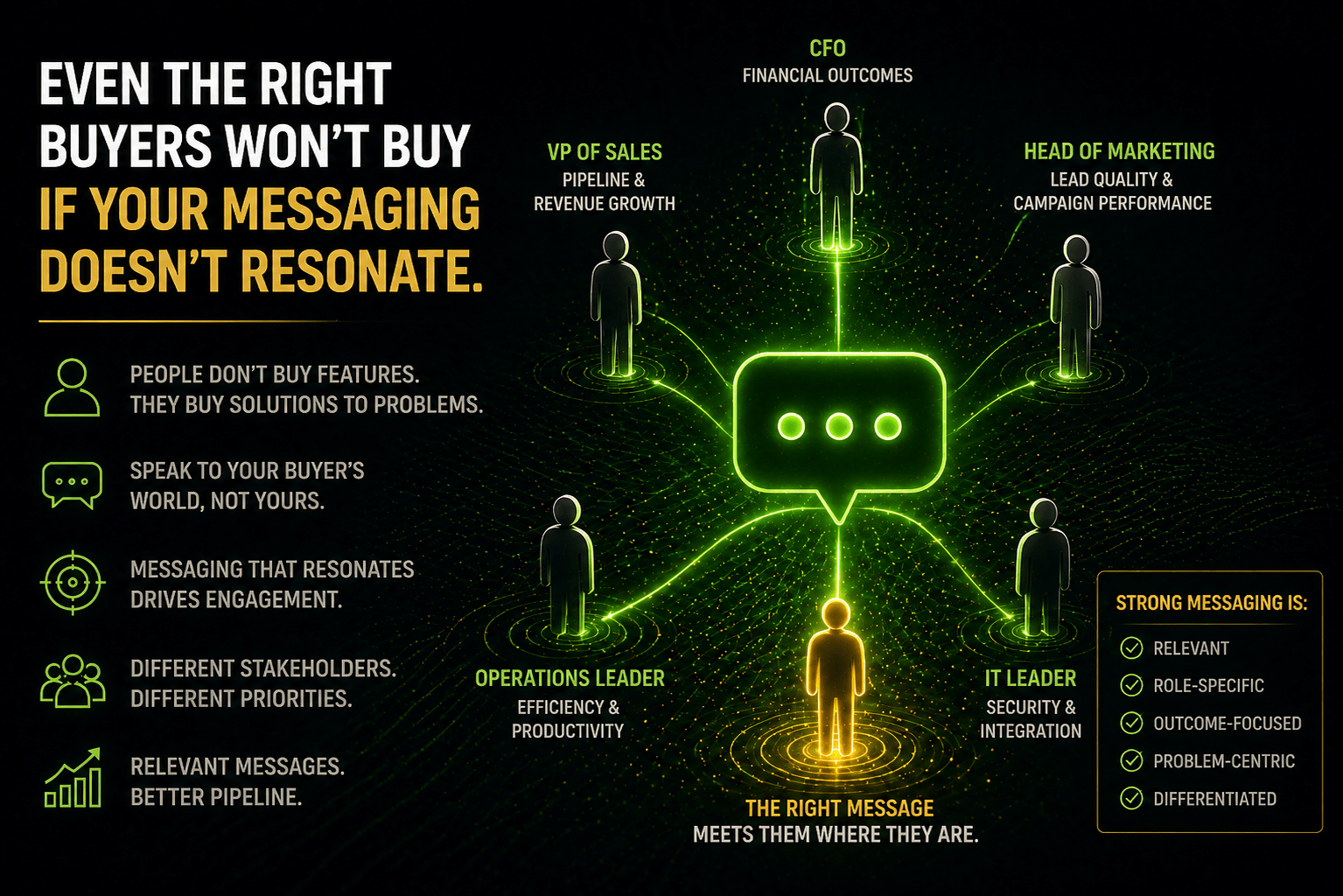
Even the Right Buyers Won’t Buy If Your Messaging Doesn’t Resonate
A surprising number of SaaS companies believe they have a lead generation problem when they actually have a messaging problem. They’ve identified their Ideal Customer Profile, built target account lists, launched outbound campaigns, increased content production, and invested in marketing technology. Yet pipeline growth remains inconsistent, sales cycles remain long, and conversion rates refuse to improve. Leadership sees the numbers and assumes the answer is more activity.
Eventually the conversation turns into:
- We need more leads. Let’s change the scoring model again.
- Crank up outbound. Smile and dial! Spam away!
- We need more content. AI can write it. It’s basically free.
- LinkedIn + YouTube + Facebook = leads, right?
- Run more campaigns. More activity equals more revenue.
So the company increases spend, adds personnel, buys more tools, and pushes harder on channels that are already underperforming. Unfortunately, if the messaging isn’t resonating with buyers, all they’ve really done is scale the inefficiency. The underlying issue was never activity. It was relevance.
Too often SaaS messaging sounds remarkably similar because it focuses on what the company wants to say rather than what the buyer actually cares about. Every vendor claims to improve efficiency, streamline workflows, reduce costs, increase productivity, and now apparently everything is powered by AI. After a while, buyers stop paying attention because every message sounds like a slightly different version of the last one.
Companies don’t buy software. People do.
And people rarely buy because they are excited about a feature set. They buy because they are trying to solve a business problem, achieve an objective, avoid a risk, or improve an outcome that matters to them personally and professionally.
People are nothing if not myopic, and view the world through their own lens. CFO’s evaluate decisions through financial outcomes. VP of Sales cares about pipeline, forecast accuracy, and revenue attainment (everyone in the company should care about pipeline, but that’s another story). A Head of Marketing focuses on lead quality, conversion rates, and campaign campaign performance (in actuality, they should care about marketing-generated pipeline – again, another story). Operations leaders care about efficiency and productivity, while IT leaders are often focused on security, integration, scalability, and supportability.
Psssst! Segmentation is actually a thing.
Yet many SaaS companies use essentially the same messaging for all of them, and then wonder why engagement is low.Strong messaging starts with understanding not only which companies are likely to buy, but also which individuals are involved in the decision, what problems they are trying to solve, and what success looks like from their perspective. Without that understanding, messaging quickly becomes generic, and generic messaging produces generic results.
One of the most common mistakes is leading with features instead of outcomes. Features matter, but they are rarely the reason someone buys. Buyers care far more about the business result than the functionality that delivers it.
Nobody buys software because of pretty dashboards, built-in workflows, or bolted-on AI. They buy because they believe those capabilities can help them solve a business problem that can’t be solved today. Their business problem, not someone in another department’s
Strong revenue engines are built on: Strong revenue engines are built on:
- A clearly defined ICP
- Target personas that reflect actual buying stakeholders
- Messaging that resonates with each audience
- Channels that consistently reach qualified buyers
- A revenue process that converts interest into revenue
Without that foundation, increasing activity rarely improves performance. It usually just creates more noise while making customer acquisition more expensive.
The fix is probably closer than you think. It doesn’t have to get to that point.
Fix the foundation: ICP, messaging, and targeting. Everything downstream gets easier. Wait too long, and you’ll be doing it under pressure with a lot less runway.
Start with a 90-minute Revenue Engine Diagnostic. From there, depending on what it needs, I can help build out a complete GTM foundation: SWOT, ICP, target personas, messaging, and content.
-
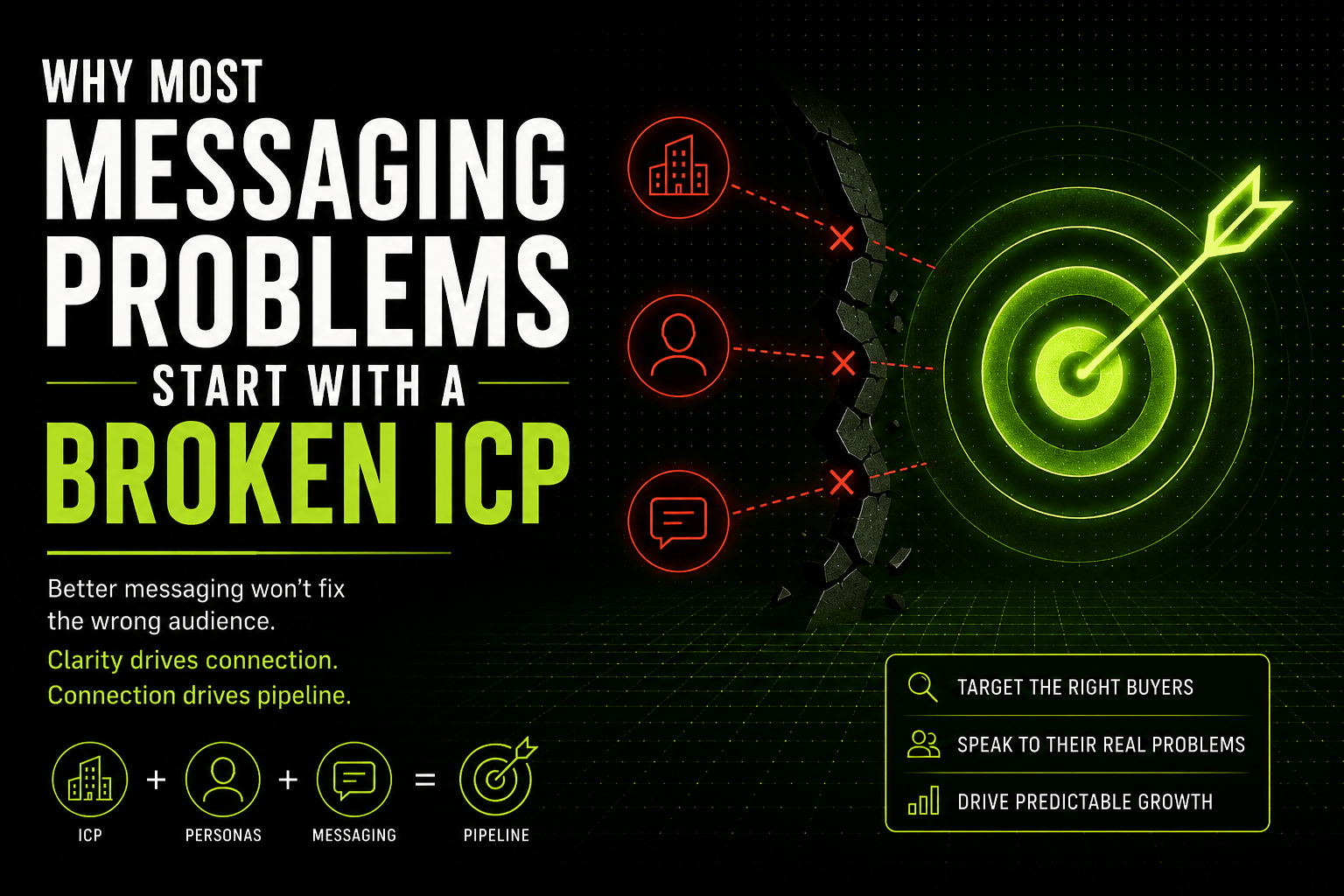
Why Most Messaging Problems Start With a Broken ICP
Weak messaging gets blamed for a lot of growth problems. Low conversion rates, poor campaign performance, inconsistent engagement, and long sales cycles all tend to trigger the same conclusion: the messaging is not working. Sometimes that is true, but in many cases messaging is not the root problem. It is the visible output of a deeper strategic issue.
Most messaging problems do not start with messaging at all. They start with a broken Ideal Customer Profile.
Messaging Is a Downstream Output
Messaging is not created in isolation. It reflects a set of upstream assumptions about who the buyer is, what problem they care about, how urgently they need to solve it, what alternatives they are considering, and what will motivate them to act. If those assumptions are wrong, the messaging will be wrong regardless of how much time gets spent refining it.
Teams often treat messaging as a copywriting exercise when the real issue is flawed market assumptions. Better copy does not fix bad assumptions.
Wrong ICP Creates Predictable Messaging Failure
When a business is targeting the wrong organizations, messaging almost always becomes less effective regardless of how polished it looks. The message feels too broad because the audience definition is too broad. The value proposition becomes generic because the company is trying to appeal to too many possible buyers. Differentiation feels weak because the chosen audience does not strongly care about the distinctions being emphasized, and calls to action underperform because the urgency being assumed does not actually exist.
This is where many teams get stuck. They see weak response and conclude the message needs refinement, when the underlying problem is that the business is speaking to the wrong people entirely.
Technical Interest Is Not Buying Intent
This problem is especially common in technically sophisticated companies. When products are innovative or technically complex, they naturally attract attention from people who appreciate the technology itself. That attention can be misleading.
Traffic looks healthy. Engagement looks encouraging. Conversations happen. But if the audience is not economically motivated to solve the problem, the message will struggle no matter how well it is written. That is not a messaging problem. It is a targeting problem.
Personas Do Not Fix Strategic Confusion
Many organizations try to solve weak messaging by building more detailed buyer personas. That can help if the ICP is already sound, but personas do not fix flawed strategic targeting.
If the business is pursuing the wrong accounts, low-urgency segments, or audiences that are not realistic buyers, more detailed personas simply create more detailed confusion. Precision in the wrong direction is not progress.
Common Symptoms of ICP and Messaging Misalignment
The warning signs tend to be familiar: healthy traffic but weak conversion, strong engagement but low buying intent, repeated sales complaints about lead quality, messaging that requires explanation before it lands, and long sales cycles where urgency never materializes.
These symptoms usually get diagnosed as campaign execution problems, but in many cases they are strategic targeting problems that no amount of campaign optimization will fix.
Better Questions to Ask
Before asking how to improve the messaging, it is worth asking whether the business is targeting actual buyers, whether the problem is economically meaningful to them, whether they feel urgency, and whether the audience is aligned with the product’s real strengths. Those questions usually lead to better answers than rewriting headlines.
Messaging Problems Are Often Strategic Problems
Strong messaging matters, but it is rarely the starting point. When ICP clarity is weak, positioning becomes unstable. When positioning is unstable, campaigns underperform. When campaigns underperform, teams blame execution while the deeper issue goes untouched.
That is why messaging problems persist longer than they should. The message is being treated as the cause instead of the symptom.
Before rewriting the story, make sure you are telling it to the right buyers.
If this feels familiar, the problem may not be messaging at all. It may be upstream in targeting, positioning, or GTM alignment.
If you want a structured way to diagnose where the real constraint lives, the Commercial Growth Triage is a good place to start: Commercial Growth Triage Diagnostic
-
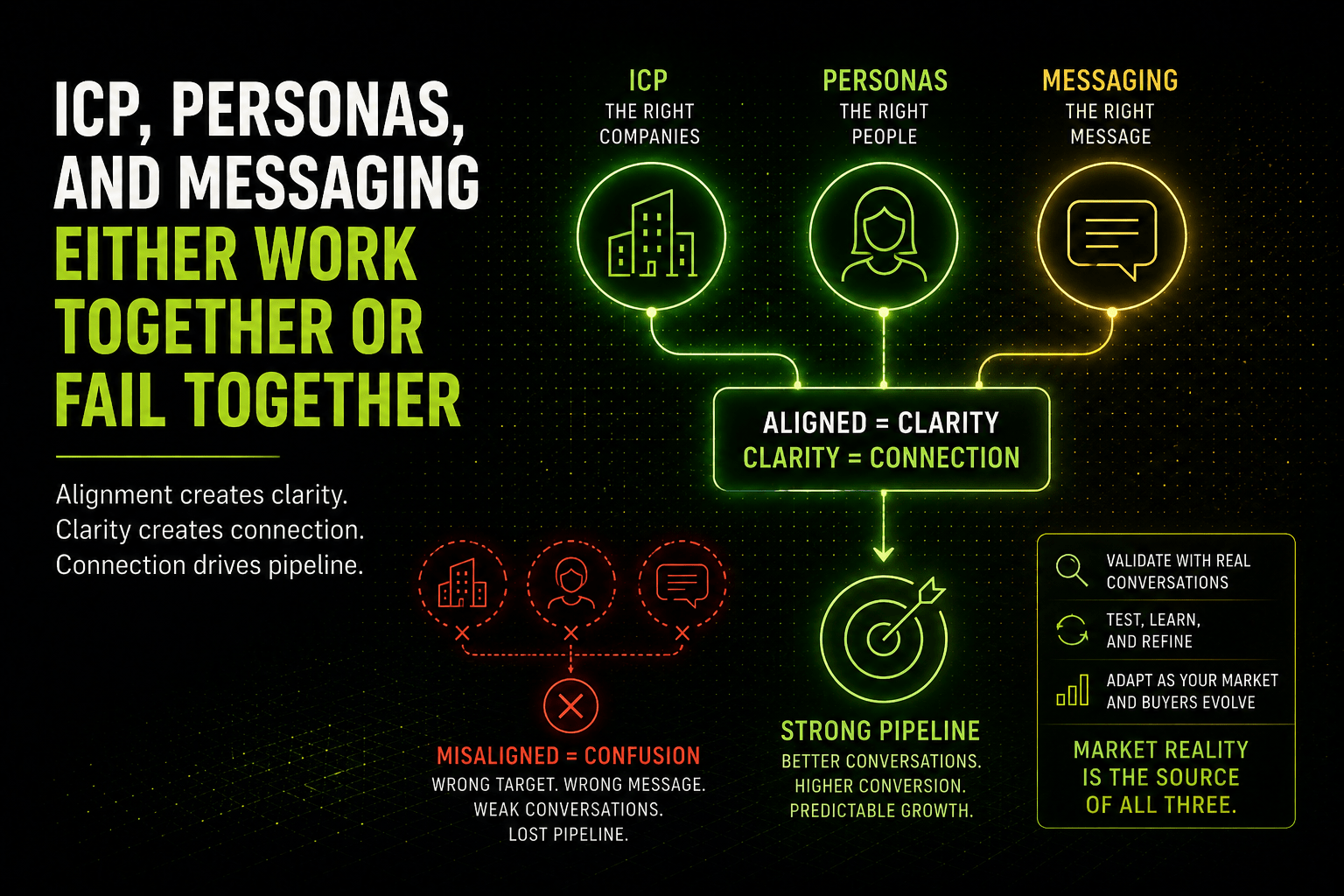
ICP, Personas, and Messaging Either Work Together or Fail Together
Most early-stage companies treat messaging as a copywriting exercise, when in reality it’s the visible output of deeper strategic work.
If your Ideal Customer Profile is wrong, your personas will be wrong. If your personas are wrong, your messaging will miss. And if your messaging misses, pipeline suffers no matter how strong the product is.
These aren’t separate exercises. They’re an interconnected system.
Internal Assumptions Usually Break the System
I see this repeatedly. Founders define an ICP based on who they think should buy, buyer personas get built around those assumptions, and messaging gets developed around product features and internal differentiation. Then campaigns underperform, and the assumption is that execution was weak.
Usually, the issue started much earlier. The system was built on internal assumptions instead of market validation.
A Conference Room Isn’t a Market
An ICP created internally is a hypothesis. A persona built without buyer conversations is assumption dressed up as strategy. Messaging developed without hearing how prospects actually describe their challenges is guesswork.
The real work starts when you get in front of customers and prospects. How do they describe the problem? What language do they use? What creates urgency? What objections consistently surface? What outcomes actually matter?
This is where real GTM strategy gets built.
Product Language Rarely Converts
One of the most common mistakes founders make is building messaging around how the product works instead of why buyers care. That logic makes perfect sense internally, but it often fails externally.
Buyers care about priorities, urgency, business outcomes, and risk. If your messaging reflects product thinking instead of buyer thinking, conversion suffers.
Validation Happens in the Market
Founders often treat ICP, personas, and messaging as exercises to complete, but the better approach is to treat them as hypotheses to validate. Real validation comes from live conversations, outbound engagement, campaign performance, and sales feedback.
If the system is right, conversations happen faster, objections become predictable, and conversion improves. If it’s wrong, the market tells you quickly.
These Inputs Evolve
Even when you get it right, the work isn’t finished. Markets shift, buyer priorities change, and competitive dynamics evolve, which means what resonated a year ago may already be stale.
Strong operators continuously refine ICP, personas, and messaging based on market feedback.
The Real Objective
Good messaging isn’t the objective. Predictable pipeline is, and messaging is simply evidence that the upstream strategic work is correct.
Stan Bowers has spent 19 years helping early-stage SaaS companies build pipeline and growth systems. The ICP and Messaging series covers the targeting and positioning decisions that determine whether a GTM motion converts or stalls.
-

What “We Need to Think About It” Is Actually Telling You
It’s Usually Not a Timing Problem
“We need to think about it” is not a timing problem. It is a messaging problem. The prospect is not asking for more time. They are telling you the value did not land clearly enough to justify internal action.
The product may be real. The problem may exist. But something in the conversation did not connect specifically enough to create urgency, and without urgency, nothing moves.
The Problem Usually Starts Upstream
I’ve seen this pattern repeatedly across early-stage companies, and the diagnosis is almost always upstream. By the time a prospect says they need to think about it, the conversation has already gone the wrong direction.
The issue usually starts with positioning that is too broad and an ICP that is not defined tightly enough to support specific messaging.
What This Looks Like in Practice
What this looks like in practice:
- Messaging that describes what the product does without connecting it to a business consequence the buyer is already feeling
- Differentiation that exists on the website but does not show up clearly in the conversation
- A prospect who understands the feature set but cannot articulate internally why it matters right now
That last one is the expensive version. A buyer who cannot make the internal case for your product is not going to move regardless of how good your follow-up sequence is.
Why Some Companies Convert More Consistently
The companies that convert consistently are not running a better sales process. They understand their buyers at a level specific enough to anticipate objections before they surface.
The conversation feels relevant immediately because the buyer recognizes their situation in the messaging. That recognition is what creates urgency. You cannot manufacture it through activity.
Where Companies Usually Get This Wrong
Where I’ve seen this break down most often is when a company interprets repeated hesitation as a sales execution problem and responds by adding volume.
- More outbound
- More demos
- More follow-up cadences
If the positioning is weak, more volume produces more of the same result at higher cost. The pipeline gets busier and conversion stays flat.
What Actually Fixes the Problem
The fix is not downstream. Tightening the ICP and sharpening the messaging changes the quality of every conversation that follows.
Discovery gets more productive. Buyers engage faster. Internal momentum builds earlier because the value is already framed in terms that make sense to the business.
The Better Question to Ask
When a deal stalls at “we need to think about it,” the question worth asking is not how to follow up better.
It is whether the right person heard a specific enough message about a problem they are already trying to solve.
If the answer to any part of that is no, the hesitation makes complete sense.
Stan Bowers has spent 19 years helping early-stage SaaS companies build pipeline and growth systems. The ICP and Messaging series covers the targeting and positioning decisions that determine whether a GTM motion converts or stalls.
-
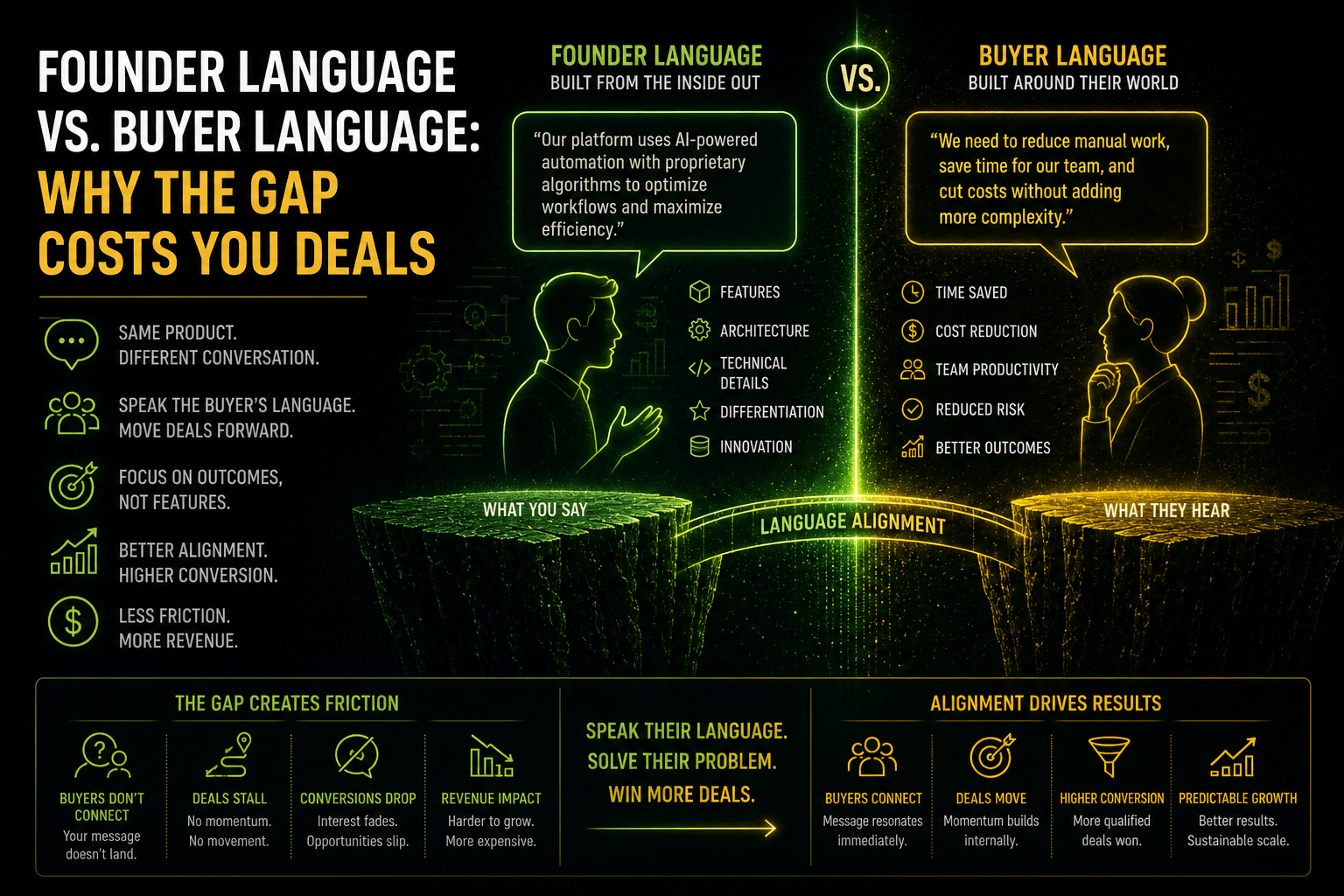
Founder Language vs. Buyer Language: Why the Gap Costs You Deals
Founders describe what they built. Buyers are trying to figure out what changes for them. Those are different conversations, and when they don’t connect, deals stall in ways that are genuinely hard to diagnose.
The product is real. The problem exists. The prospect showed up to the demo. And then nothing moves. That pattern almost always traces back to a language gap, not a product gap.
Founder Language Is Built from the Inside Out
Founder language is built from the inside out. Features, architecture, differentiation, what makes the solution technically interesting. That framing makes complete sense to anyone who built the thing. It means almost nothing to a buyer who is trying to justify a decision to their CFO or explain the value to their operations team.
Buyer Language Is Built Around the Problem
Buyers don’t think in product terms. They think in operational terms. Time lost. Costs that shouldn’t exist. Work that is harder than it should be.
When your messaging doesn’t reflect that, the buyer has to do the translation themselves. Most won’t bother. They’ll just move on or go quiet, and you’ll never quite know why.
Where This Shows Up in the Funnel
What this looks like in practice:
- Messaging that describes what the product does but skips why it matters to this specific buyer
- Discovery calls that stay surface-level because the language isn’t landing
- Demos that make technical sense but don’t connect to anything the buyer is actually trying to fix
- Deals that keep moving forward on paper but have no real internal momentum behind them
Why It Gets Misdiagnosed
I’ve seen this misread as a pipeline problem repeatedly. The funnel looks active. Conversations are happening. But conversion is soft and no one can explain why.
The answer is almost always upstream, in the framing, not the follow-up.
What Changes When the Language Aligns
When the language shifts, the conversation changes quickly. The buyer stops having to interpret what they’re seeing and starts connecting it directly to their situation.
Internal selling gets easier because the value is already framed in terms that make sense to the business. Deals that were stalling start moving, and nothing about the product changed.
Why This Isn’t a Copy Problem
The fix is not a copy refresh. Rewriting a few lines on the website doesn’t close this gap. If the underlying understanding of the buyer is off, the language will be off regardless of how well it’s written.
What’s usually missing is the actual words buyers use when they describe their problems without being prompted. That language exists. It comes out in sales calls, in customer conversations, in the moments when someone is explaining their situation before they’ve heard your pitch.
Most companies aren’t capturing it. And when they do capture it, they’re not using it consistently across their messaging.
The Cost of the Gap
The gap between how a founder describes a product and how a buyer describes their problem is one of the more expensive misalignments in early-stage go-to-market.
It doesn’t look broken. The pipeline is moving, the team is working, the product is solid. It just doesn’t convert the way it should.
That’s what makes it hard to catch. And why it’s worth looking at before you add more volume to a funnel where the messaging isn’t doing its job.
Stan Bowers has spent 19 years helping early-stage SaaS companies build pipeline and growth systems. The ICP and Messaging series covers the targeting and positioning decisions that determine whether a GTM motion converts or stalls.
-
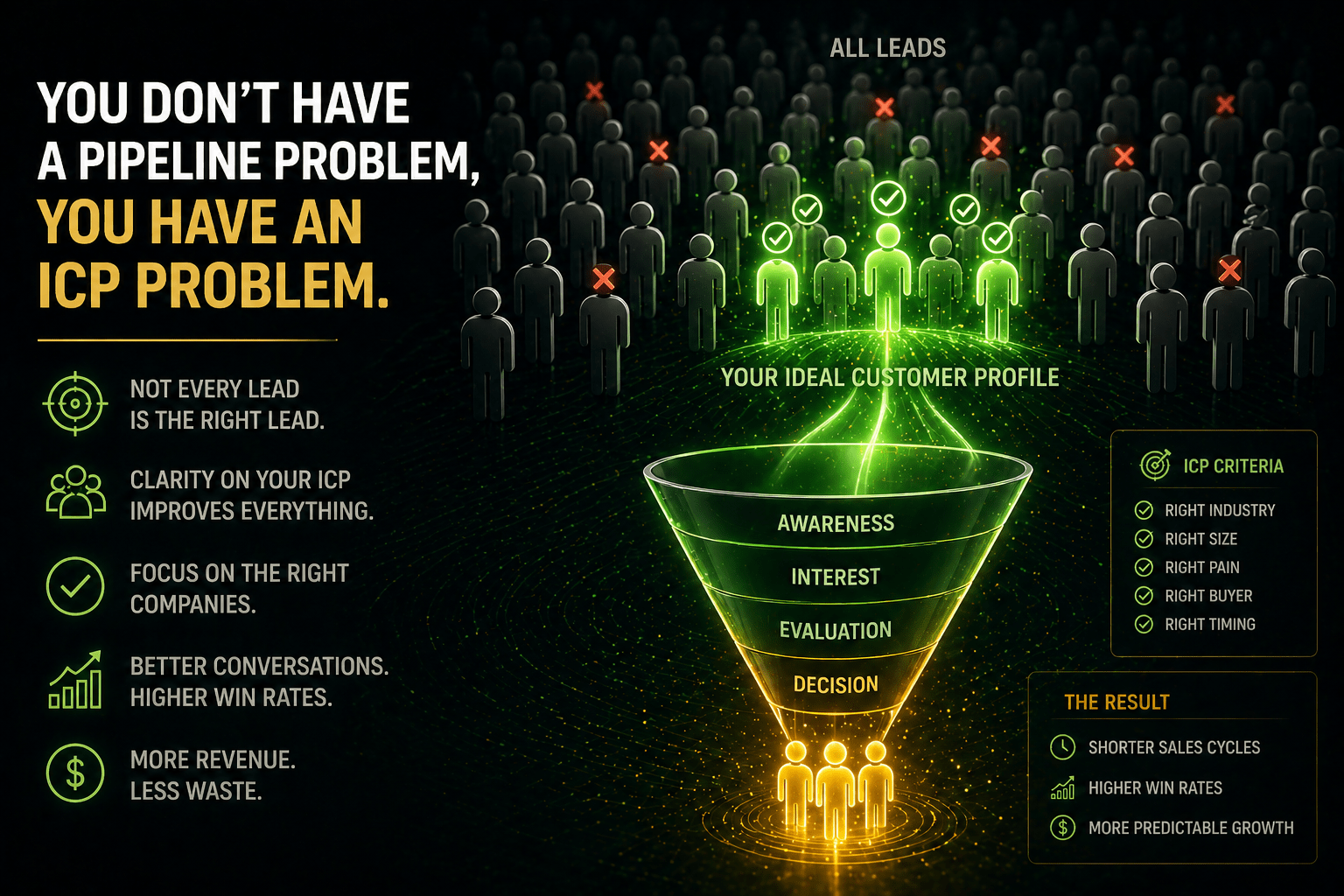
You Don’t Have a Pipeline Problem, You Have an ICP Problem
The meetings are happening. Demos are getting booked. Opportunities are sitting in the pipeline. On paper, the funnel looks active. But deals are stalling, win rates are soft, sales cycles are stretching, and no one can quite explain why.
Before you add more outbound, hire another SDR, or rework your sequences, consider a different diagnosis: the problem usually isn’t volume. It’s who you’re talking to.
Most early-stage SaaS companies that struggle with pipeline conversion are not suffering from a demand generation failure. They are suffering from a targeting failure. The funnel is full of the wrong people, and no amount of follow-up, nurturing, or closing technique fixes that.
Why founders misread this as a pipeline problem
The misdiagnosis is understandable. When revenue isn’t growing the way it should, the visible symptom is pipeline. Deals aren’t closing. Conversion rates are low. The natural response is to put more in at the top and hope something improves downstream.
This logic fails because it treats pipeline as a volume problem when it’s actually a quality problem. Adding more leads to a funnel that’s converting at 8% doesn’t get you to 20%. It gets you to 8% of a larger number, at higher cost, with a team that is working harder and winning less.
The harder thing to accept is that the problem started before the lead ever entered the funnel. It started when someone decided who to go after.
Founders make ICP decisions early, often under pressure, and rarely revisit them with enough rigor. The initial ICP is usually built on a combination of founder intuition, the profile of the first few customers who said yes, and a reasonable guess about who should care about the product. That’s a hypothesis, not a targeting strategy. Treating it as settled is where the compounding begins.
What ICP failure actually looks like in practice
It doesn’t always look like obvious chaos. Sometimes it looks like a reasonably busy pipeline that just never quite converts.
Specific signs to watch for:
Long sales cycles with no clear reason. When deals take two or three times longer than they should, it often means the prospect never had genuine urgency. They were interested, but the problem your product solves wasn’t painful enough, frequent enough, or expensive enough to prioritize. That’s a fit problem, not a sales execution problem.
Win rates that vary wildly by rep. When one seller closes at 35% and another closes at 12%, the instinct is to look at skill. Sometimes that’s right. But often the high performer has unconsciously figured out which accounts to avoid and which ones are worth pursuing. They have developed an informal ICP through pattern recognition. The low performer is working the full list.
Deals that die after the demo. A prospect who shows up to a demo, engages, asks questions, and then goes quiet is not a sales execution failure. It usually means the demo confirmed that the product is interesting but not the right fit for their specific situation right now. They were the wrong person at the wrong time, and the qualification process didn’t catch it.
Discounts used to close. When price becomes the primary lever to get deals across the line, that is almost always a signal that the buyer doesn’t value the product enough to pay for it at full price. That is a fit problem. The right customer, with the right pain, at the right time, argues about contract terms. They don’t argue about whether the price is worth it.
Your sales team already knows
Before you look at the data, talk to the people running deals. Sales reps develop strong intuitions about which prospects will close and which ones are a waste of time. They often know within the first two conversations whether a deal is real.
Ask them directly: which types of companies do you actually win? Which ones feel like a grind from the start? What questions do prospects ask when they’re serious versus when they’re just looking?
The answers will likely point you at a tighter, more specific version of your ICP than what’s written in your positioning document. The gap between those two things is worth understanding.
How to pressure test your ICP with real data
Once you’ve talked to the team, go to the data. The most useful place to start is your closed-won history from the last 12 to 18 months.
Look for patterns across the deals you actually won. Not just company size and industry, but the specific characteristics of the buyer: their role, their level of internal authority, the trigger that caused them to be looking in the first place, the competitive situation, the urgency driver. Look at what those deals had in common that your average pipeline deal does not.
Then do the same thing with your closed-lost data, specifically the deals you lost to “no decision.” Not lost to a competitor, but lost because nothing happened. Those are almost always ICP misses. The prospect liked the product well enough to spend time evaluating it but didn’t like it enough to do anything about it. That’s a fit problem wearing a timing costume.
When you compare those two sets side by side, the targeting signal becomes hard to ignore. The companies that bought share attributes that most of your active pipeline does not. That gap is your ICP problem made visible.
What strong ICP clarity actually changes
A well-defined ICP doesn’t just improve win rates. It changes how the entire GTM motion operates.
Qualification gets faster because reps know what they’re looking for and what disqualifies a prospect early. Discovery gets more specific because you know which problems matter most to the customers you actually win. Messaging gets sharper because you’re writing for a real person with a real problem instead of an average of everyone who might conceivably use the product. And pipeline reviews become more honest because the question shifts from “is this a real deal?” to “does this match the profile of companies we win?”
The downstream effect on sales cycle length, conversion rate, and CAC is significant. Not because anyone worked harder, but because the effort is going toward the right accounts.
What to do this week
Three things, in order.
First, pull your last 20 closed-won deals and identify the three or four characteristics they share that are not present in most of your current pipeline. Write those down.
Second, look at your current pipeline and count how many active opportunities match that profile. Be honest about the ones that don’t.
Third, talk to two or three reps and ask them which current deals feel real and which ones feel like they’re going through the motions. Listen closely to how they describe the difference.
What you find will likely be more useful than another quarter of optimizing conversion tactics on a funnel full of the wrong people.
The fix is upstream
Pipeline problems that live at the bottom of the funnel usually started at the top. The conversion rate, the win rate, the sales cycle length: all of those are symptoms. The cause is who got into the funnel in the first place.
Fixing that requires the discipline to be more selective, to say no to accounts that don’t fit even when pipeline feels thin, and to treat your ICP as a living business decision rather than a founding assumption you documented once and forgot about.
The companies that grow efficiently are not the ones with the most pipeline. They are the ones where most of what’s in the pipeline should actually be there.
That distinction is worth more than any demand generation campaign you could run this quarter.
Stan Bowers has spent 19 years helping early-stage SaaS companies build pipeline and growth systems. The ICP and Messaging series covers the targeting and positioning decisions that determine whether a GTM motion converts or stalls.
-
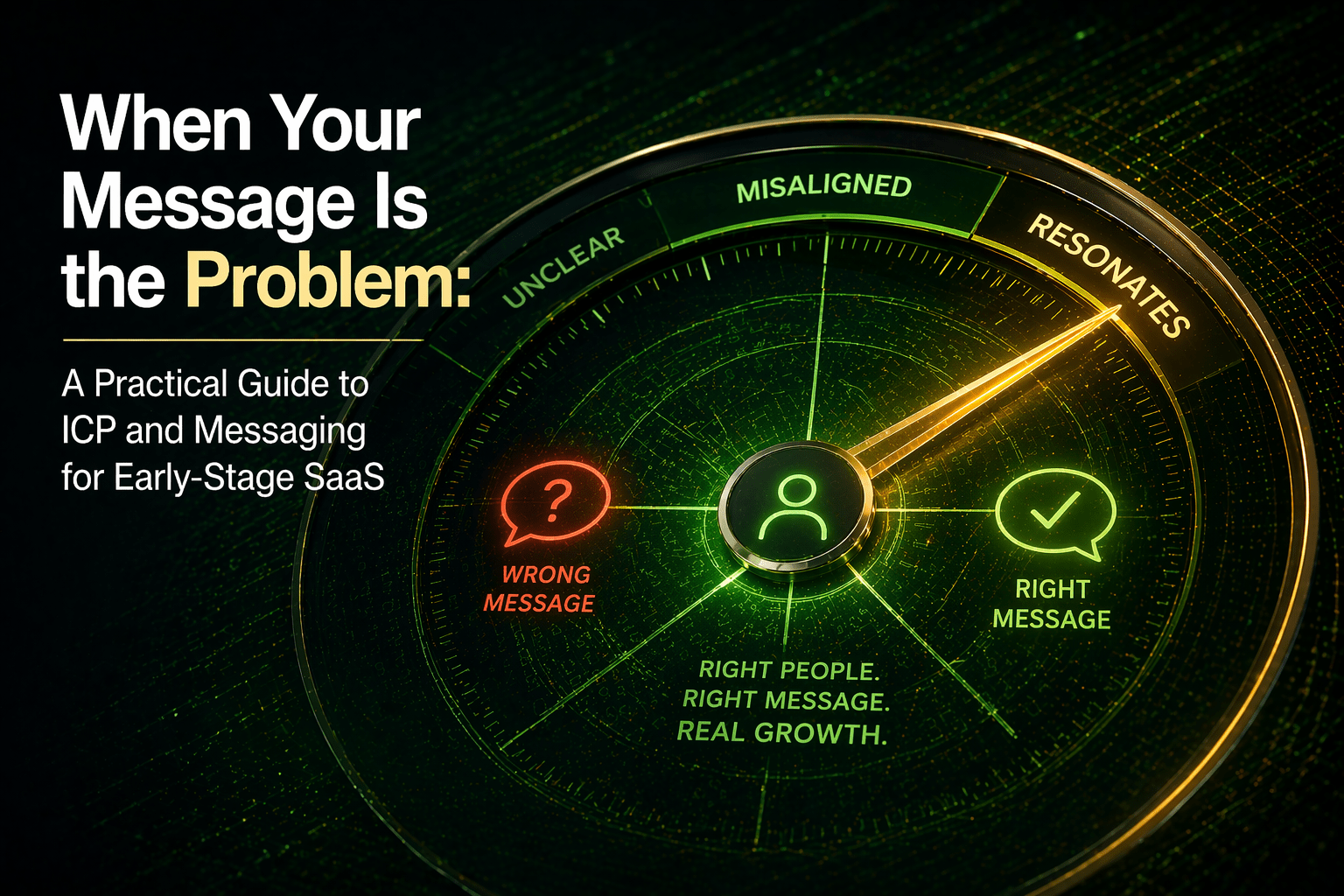
When Your Message Is the Problem: A Practical Guide to ICP and Messaging for Early-Stage SaaS
Most early-stage SaaS companies don’t have a pipeline problem. They have a messaging problem. The two look identical from the inside, which is why the wrong one gets fixed most of the time.
This series is about getting your message right before you scale anything else.
Over the next several posts I will cover how to define your ideal customer profile, how to build messaging that actually resonates, and how to know when your positioning is costing you deals you should be winning. The material comes from working directly with early-stage teams who had strong products and weak pipelines, and figuring out why.
The topics will include ICP development, persona building, messaging frameworks, and how to pressure test your positioning before it becomes a revenue problem.
If you are a founder who has ever heard “we need to think about it” more times than you can count, or a marketing leader trying to explain why the message isn’t landing, this series is for you.
The first post goes up next week.
-
Subscribe
Subscribed
Already have a WordPress.com account? Log in now.
 stanbowers.com