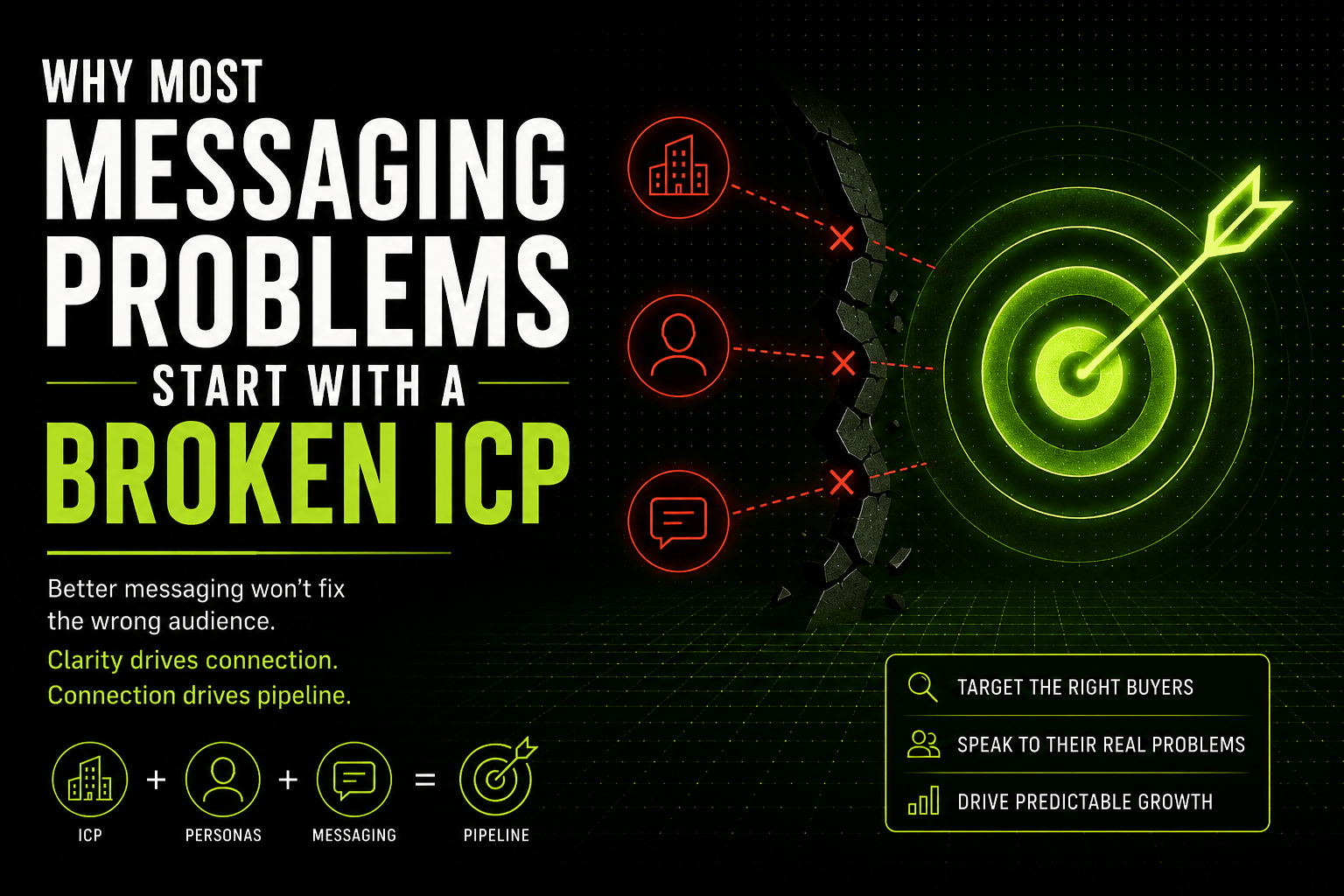
Weak messaging gets blamed for a lot of growth problems. Low conversion rates, poor campaign performance, inconsistent engagement, and long sales cycles all tend to trigger the same conclusion: the messaging is not working. Sometimes that is true, but in many cases messaging is not the root problem. It is the visible output of a deeper strategic issue.
Most messaging problems do not start with messaging at all. They start with a broken Ideal Customer Profile.
Messaging Is a Downstream Output
Messaging is not created in isolation. It reflects a set of upstream assumptions about who the buyer is, what problem they care about, how urgently they need to solve it, what alternatives they are considering, and what will motivate them to act. If those assumptions are wrong, the messaging will be wrong regardless of how much time gets spent refining it.
Teams often treat messaging as a copywriting exercise when the real issue is flawed market assumptions. Better copy does not fix bad assumptions.
Wrong ICP Creates Predictable Messaging Failure
When a business is targeting the wrong organizations, messaging almost always becomes less effective regardless of how polished it looks. The message feels too broad because the audience definition is too broad. The value proposition becomes generic because the company is trying to appeal to too many possible buyers. Differentiation feels weak because the chosen audience does not strongly care about the distinctions being emphasized, and calls to action underperform because the urgency being assumed does not actually exist.
This is where many teams get stuck. They see weak response and conclude the message needs refinement, when the underlying problem is that the business is speaking to the wrong people entirely.
Technical Interest Is Not Buying Intent
This problem is especially common in technically sophisticated companies. When products are innovative or technically complex, they naturally attract attention from people who appreciate the technology itself. That attention can be misleading.
Traffic looks healthy. Engagement looks encouraging. Conversations happen. But if the audience is not economically motivated to solve the problem, the message will struggle no matter how well it is written. That is not a messaging problem. It is a targeting problem.
Personas Do Not Fix Strategic Confusion
Many organizations try to solve weak messaging by building more detailed buyer personas. That can help if the ICP is already sound, but personas do not fix flawed strategic targeting.
If the business is pursuing the wrong accounts, low-urgency segments, or audiences that are not realistic buyers, more detailed personas simply create more detailed confusion. Precision in the wrong direction is not progress.
Common Symptoms of ICP and Messaging Misalignment
The warning signs tend to be familiar: healthy traffic but weak conversion, strong engagement but low buying intent, repeated sales complaints about lead quality, messaging that requires explanation before it lands, and long sales cycles where urgency never materializes.
These symptoms usually get diagnosed as campaign execution problems, but in many cases they are strategic targeting problems that no amount of campaign optimization will fix.
Better Questions to Ask
Before asking how to improve the messaging, it is worth asking whether the business is targeting actual buyers, whether the problem is economically meaningful to them, whether they feel urgency, and whether the audience is aligned with the product’s real strengths. Those questions usually lead to better answers than rewriting headlines.
Messaging Problems Are Often Strategic Problems
Strong messaging matters, but it is rarely the starting point. When ICP clarity is weak, positioning becomes unstable. When positioning is unstable, campaigns underperform. When campaigns underperform, teams blame execution while the deeper issue goes untouched.
That is why messaging problems persist longer than they should. The message is being treated as the cause instead of the symptom.
Before rewriting the story, make sure you are telling it to the right buyers.
If this feels familiar, the problem may not be messaging at all. It may be upstream in targeting, positioning, or GTM alignment.
If you want a structured way to diagnose where the real constraint lives, the Commercial Growth Triage is a good place to start: Commercial Growth Triage Diagnostic
 stanbowers.com