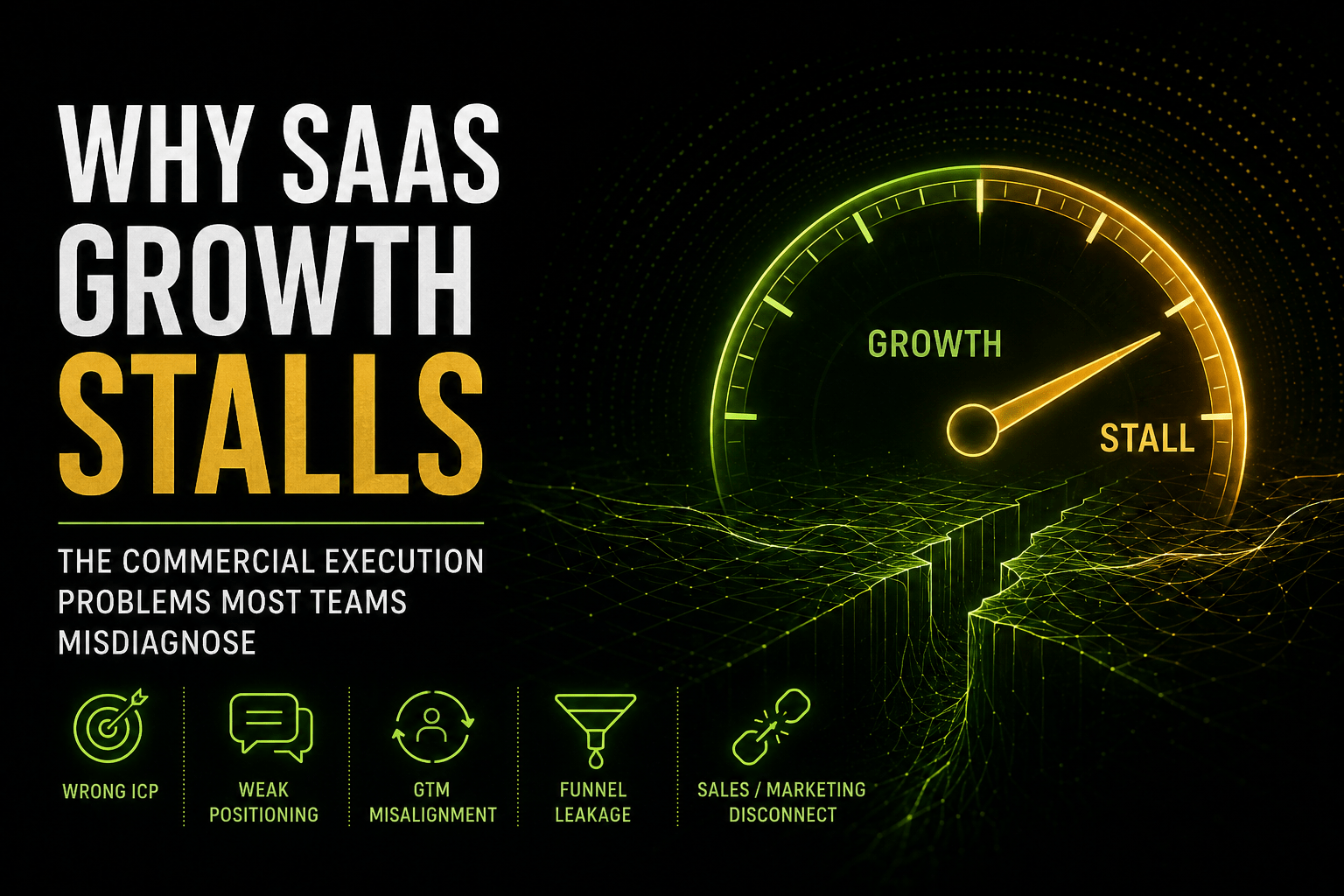
Growth stalls rarely happen for the reasons companies initially assume. When revenue slows, pipeline weakens, conversion drops, or sales velocity deteriorates, the default reaction is often the same: generate more leads. That instinct is understandable. More activity feels like progress. In many cases, it simply amplifies the existing problem instead of solving it.
Weak growth is often not a lead generation problem. It is a commercial execution problem.
The Symptom Gets Mistaken for the Cause
Leadership teams typically see the visible symptoms first: missed revenue targets, weak pipeline, declining conversion, longer sales cycles, poor forecast confidence, and sustained complaints about lead quality. The conclusion is often immediate; marketing needs to create more demand. Sometimes that is true, but more often it is not.
Pipeline problems are frequently downstream symptoms of upstream strategic or operational failures, and adding more leads to a broken system creates more waste, not more revenue. The instinct to increase volume is not inherently wrong, but acting on it before understanding what is actually broken is one of the more reliable ways to make a bad situation more expensive.
Where Growth Actually Breaks
In my experience working across nine startups over 19 years, stalled growth tends to come from a small number of recurring issues, most of which are diagnosable and very few of which are actually a lead volume problem.
Wrong ICP
If the business is targeting organizations that are unlikely to buy, difficult to convert, or poorly aligned with the product’s real strengths, demand generation becomes inefficient by default. This typically shows up as poor lead quality, low conversion, and long, unproductive sales cycles. It also creates persistent friction between sales and marketing, where sales rejects what marketing sends, and marketing defends the leads, often with both sides partially right.
The issue is not campaign execution. When the ICP is off, better campaigns do not fix the problem; they just spend more money reaching the wrong people faster. This is a targeting problem, not a campaign problem.
Weak Positioning
A product can be genuinely strong while the market narrative around it is weak. If buyers do not quickly understand why the problem matters, why now is the right time to act, why your solution is the right answer, and why your company is the right partner, conversion suffers at every stage of the funnel.
This often gets misdiagnosed as a traffic or volume problem when the real issue is message clarity and market relevance. Positioning problems are particularly hard to see from inside the company because the product makes complete sense to the people building it. What they often miss is that buyers encounter the message without any of that internal context, and if the message consistently requires explanation to land, it is not working yet.
GTM Misalignment
Sales, marketing, product, and leadership can all be individually competent while operating from fundamentally different assumptions about who they are selling to, what the market actually cares about, and what the company does. When that happens, marketing attracts the wrong audience, sales rejects the leads, messaging becomes inconsistent across channels and conversations, campaigns fail to convert, and execution loses focus.
This is one of the most common commercial growth constraints I see, and one of the most expensive, because the waste is largely invisible. Everyone is working hard, the activity metrics look reasonable, and the numbers still do not move the way they should. GTM misalignment is not a failure of effort. It is a failure of coordination, and it rarely resolves on its own without someone forcing the conversation.
Funnel Leakage
Not all growth problems begin at the top of the funnel. Many companies are simply losing too much value in the middle through poor qualification, weak nurture, ineffective handoffs between marketing and sales, unclear ownership of stalled opportunities, and inconsistent follow-up once a deal is in the pipeline. These problems rarely show up in board decks, but they compound quickly.
In these situations, adding more top-of-funnel activity can actually make the unit economics worse, because the leak stays in place while the cost of filling the pipeline increases. Before increasing spend or outbound activity, it is worth understanding where current opportunities are dying and why.
Sales and Marketing Disconnect
This remains one of the most expensive growth problems in B2B organizations, and one of the most stubborn. When marketing is measured on activity metrics while sales is measured on revenue, alignment breaks down quickly because the incentives point in different directions and the feedback loops between teams are too weak to course-correct in real time. The result is inconsistent pipeline performance, poor accountability, circular lead quality debates that resolve nothing, and a persistent gap between marketing effort and revenue outcomes that neither team can fully explain or fix independently.
This is not a demand problem. It is an operating model problem, and the fix requires shared definitions, shared metrics, and a shared understanding of what good looks like at each stage of the funnel. That kind of alignment does not happen by accident, and it does not happen by telling both teams to collaborate more.
The Cost of Misdiagnosis
Misdiagnosing growth constraints creates predictable and avoidable waste. Companies respond by increasing spend, launching more campaigns, changing agencies, hiring additional SDRs, and pushing existing teams harder, none of which addresses the actual constraint. The root cause stays in place, the results do not improve meaningfully, and the organization burns through budget and energy without understanding why.
Teams work harder and see diminishing returns. Leadership loses confidence in the go-to-market motion. Good people eventually leave. More activity is not the same thing as better growth, and the gap between those two things is where most misdiagnosed growth problems actually live.
Growth Problems Are Usually Diagnosable
Stalled growth is rarely random. In most cases, the underlying issue can be identified through structured analysis across a relatively small set of variables: ICP and market alignment, positioning and messaging effectiveness, demand generation performance, funnel conversion rates, sales and marketing execution, and retention and expansion dynamics.
The most common mistake is treating symptoms rather than causes, and the most common symptom companies treat is lead volume, because it is concrete, measurable, and feels like action. But adding leads to a broken commercial system does not fix the system. It makes the problems harder to see and more expensive to carry. The right response is diagnosis before action: find the actual constraint, address that specifically, and then scale what is working.
If growth has stalled, the issue is usually diagnosable. If you want a structured assessment of where the constraint actually lives, Commercial Growth Triage is designed for exactly that.
 stanbowers.com