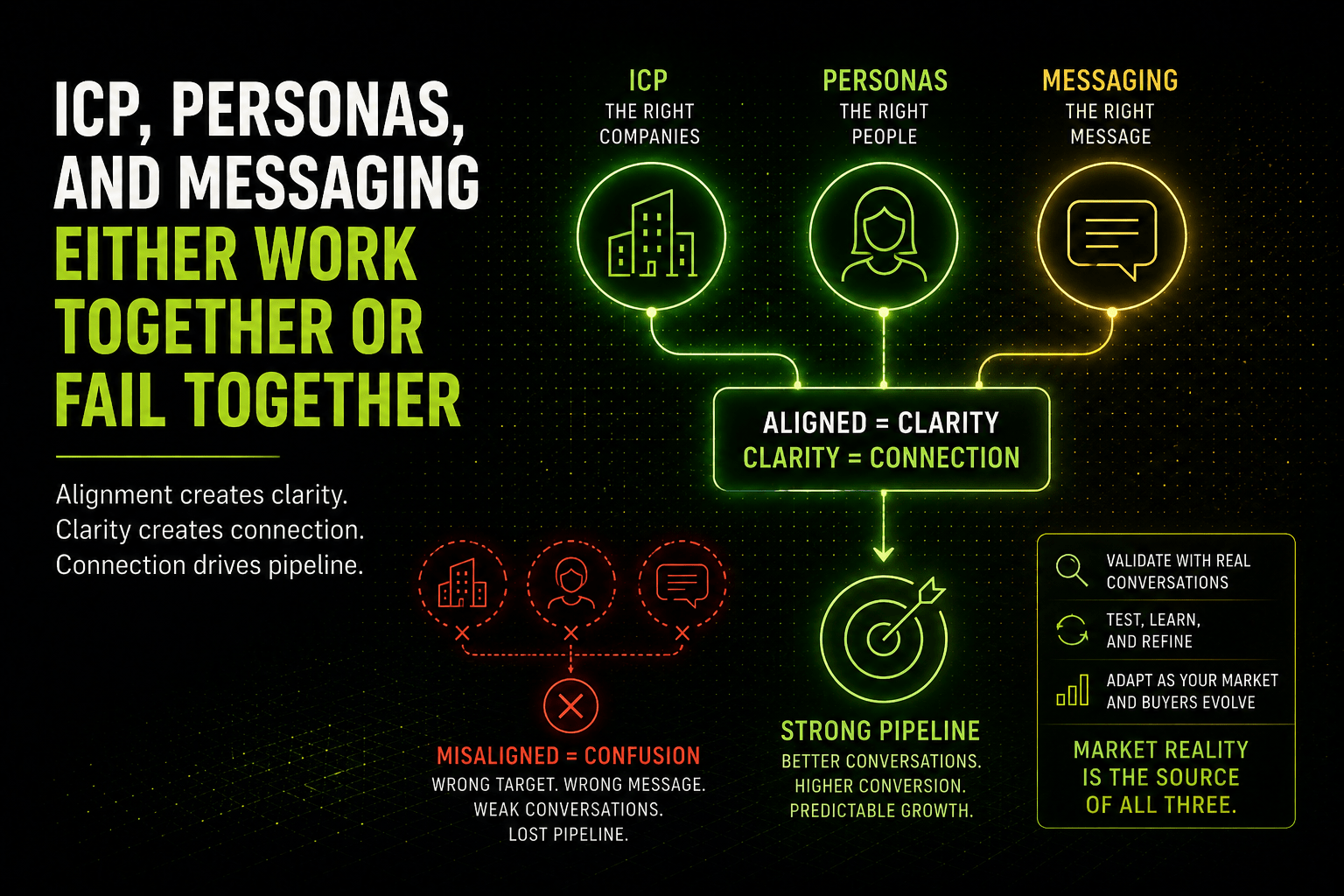
Most early-stage companies treat messaging as a copywriting exercise, when in reality it’s the visible output of deeper strategic work.
If your Ideal Customer Profile is wrong, your personas will be wrong. If your personas are wrong, your messaging will miss. And if your messaging misses, pipeline suffers no matter how strong the product is.
These aren’t separate exercises. They’re an interconnected system.
Internal Assumptions Usually Break the System
I see this repeatedly. Founders define an ICP based on who they think should buy, buyer personas get built around those assumptions, and messaging gets developed around product features and internal differentiation. Then campaigns underperform, and the assumption is that execution was weak.
Usually, the issue started much earlier. The system was built on internal assumptions instead of market validation.
A Conference Room Isn’t a Market
An ICP created internally is a hypothesis. A persona built without buyer conversations is assumption dressed up as strategy. Messaging developed without hearing how prospects actually describe their challenges is guesswork.
The real work starts when you get in front of customers and prospects. How do they describe the problem? What language do they use? What creates urgency? What objections consistently surface? What outcomes actually matter?
This is where real GTM strategy gets built.
Product Language Rarely Converts
One of the most common mistakes founders make is building messaging around how the product works instead of why buyers care. That logic makes perfect sense internally, but it often fails externally.
Buyers care about priorities, urgency, business outcomes, and risk. If your messaging reflects product thinking instead of buyer thinking, conversion suffers.
Validation Happens in the Market
Founders often treat ICP, personas, and messaging as exercises to complete, but the better approach is to treat them as hypotheses to validate. Real validation comes from live conversations, outbound engagement, campaign performance, and sales feedback.
If the system is right, conversations happen faster, objections become predictable, and conversion improves. If it’s wrong, the market tells you quickly.
These Inputs Evolve
Even when you get it right, the work isn’t finished. Markets shift, buyer priorities change, and competitive dynamics evolve, which means what resonated a year ago may already be stale.
Strong operators continuously refine ICP, personas, and messaging based on market feedback.
The Real Objective
Good messaging isn’t the objective. Predictable pipeline is, and messaging is simply evidence that the upstream strategic work is correct.
Stan Bowers has spent 19 years helping early-stage SaaS companies build pipeline and growth systems. The ICP and Messaging series covers the targeting and positioning decisions that determine whether a GTM motion converts or stalls.
 stanbowers.com