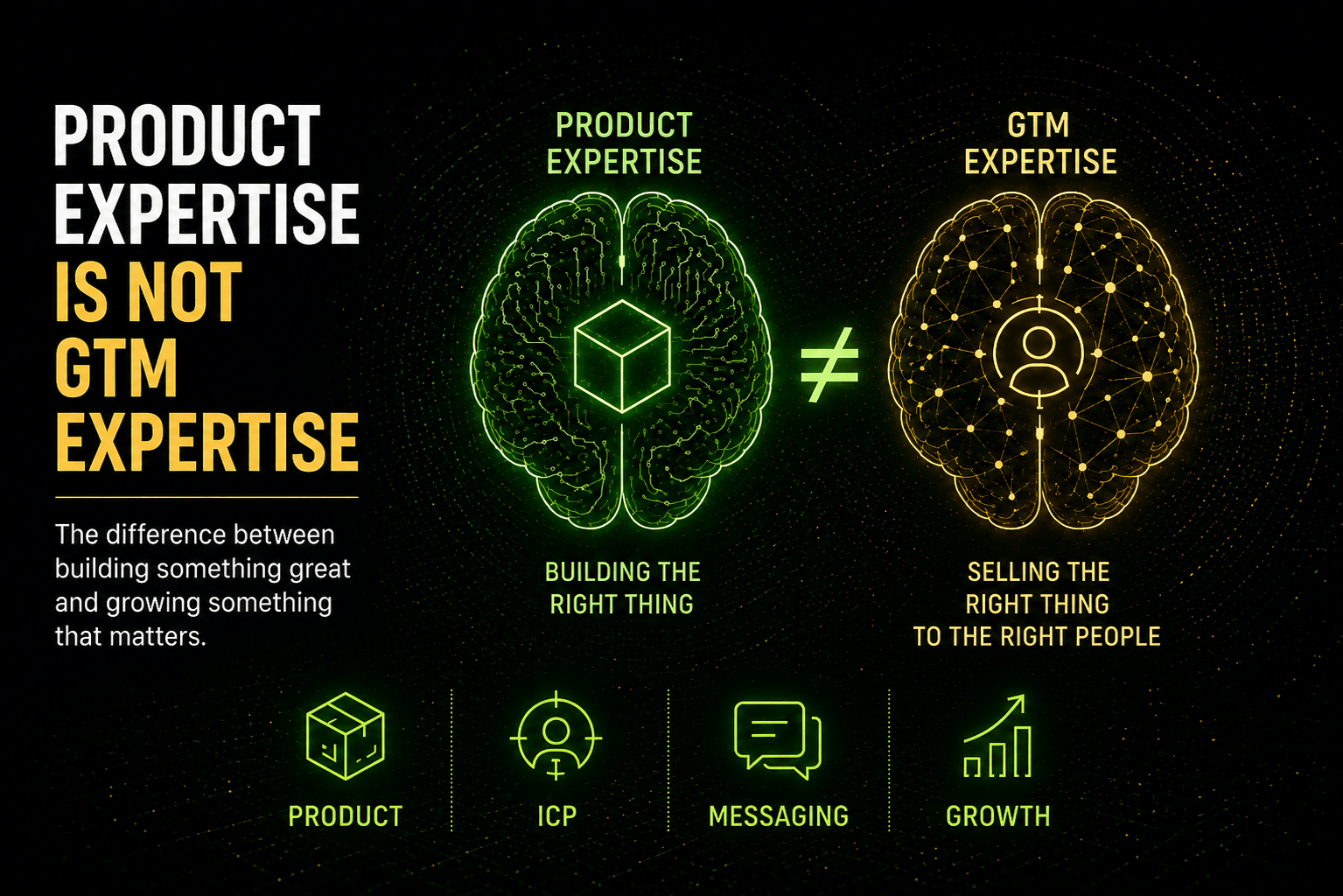
Most founders know their product better than anyone, and that is rarely the issue. The issue is assuming product expertise translates into go-to-market expertise, and most of the time, it doesn’t.
Building something valuable and commercializing it are two very different disciplines. I have seen brilliant founders struggle with GTM, not because the product was weak, but because they assumed understanding what they built meant they understood how the market would buy it.
The Most Expensive GTM Mistake Is Internal Assumption
One of the fastest ways to waste time and capital is building your GTM strategy around internal assumptions. Who is the buyer? What problem feels urgent enough to solve? What language resonates? Which objections actually matter?
Founders often answer these questions from inside the company, but the market answers them very differently, and that disconnect is where momentum dies.
GTM Is a Process, Not Industry Trivia
People often assume outside expertise means bringing in someone with decades in the specific industry. While that can help, that isn’t usually the core issue.
The real value is bringing in someone who understands the GTM process., and has the ability to:
- Align sales and marketing around what actually converts.
- Determine market fit.
- Identify the correct ICP.
- Build buyer personas.
- Test messaging against real conversations.
I have done this nine times across different companies and categories. While the product changed, the process didn’t.
Product Expertise Can Create Blind Spots
At one company, which has since been acquired, the founders were data scientists, so naturally, the company focused on selling to data scientists. That made perfect sense internally, but it didn’t reflect how the market actually bought.
We repositioned around business users and business outcomes instead of technical capability. ACV tripled. That wasn’t about understanding NLP better than the founders, it was about understanding commercialization better.
Market Validation Beats Internal Consensus
At another company, success did not come from pretending to be an industry veteran. It came from getting in front of customers, listening to how prospects described their challenges, learning the terminology they actually used, understanding where urgency existed, and working closely with sales to pressure-test positioning and messaging against live conversations.
That’s the process, it’s not guessing, not assumptions, and not internal consensus.
Outside Expertise Accelerates Learning
Founders should absolutely own product vision, but they do not need to be experts in every discipline required to scale. Outside GTM expertise creates leverage because it shortens the learning curve, not because outsiders know the product better, but because they know how to determine who will buy it, why they will care, and how to build repeatable traction faster.
Knowing what you do not know isn’t weakness. It’s operating discipline.
Stan Bowers has spent 19 years helping early-stage SaaS companies build pipeline and growth systems. This series covers the decisions that matter most in the first 12 to 24 months of building a marketing and revenue function.
 stanbowers.com