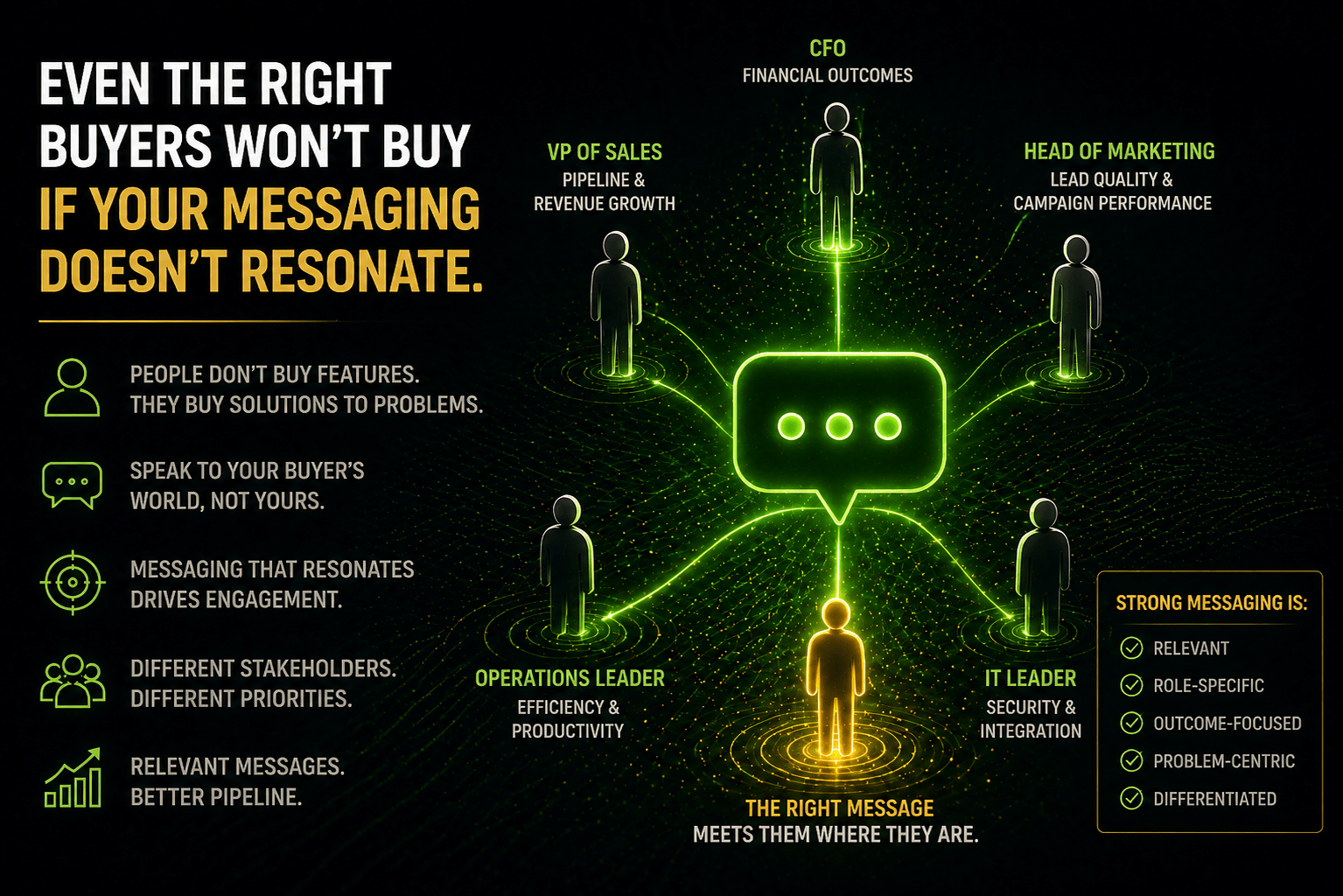
A surprising number of SaaS companies believe they have a lead generation problem when they actually have a messaging problem. They’ve identified their Ideal Customer Profile, built target account lists, launched outbound campaigns, increased content production, and invested in marketing technology. Yet pipeline growth remains inconsistent, sales cycles remain long, and conversion rates refuse to improve. Leadership sees the numbers and assumes the answer is more activity.
Eventually the conversation turns into:
- We need more leads. Let’s change the scoring model again.
- Crank up outbound. Smile and dial! Spam away!
- We need more content. AI can write it. It’s basically free.
- LinkedIn + YouTube + Facebook = leads, right?
- Run more campaigns. More activity equals more revenue.
So the company increases spend, adds personnel, buys more tools, and pushes harder on channels that are already underperforming. Unfortunately, if the messaging isn’t resonating with buyers, all they’ve really done is scale the inefficiency. The underlying issue was never activity. It was relevance.
Too often SaaS messaging sounds remarkably similar because it focuses on what the company wants to say rather than what the buyer actually cares about. Every vendor claims to improve efficiency, streamline workflows, reduce costs, increase productivity, and now apparently everything is powered by AI. After a while, buyers stop paying attention because every message sounds like a slightly different version of the last one.
Companies don’t buy software. People do.
And people rarely buy because they are excited about a feature set. They buy because they are trying to solve a business problem, achieve an objective, avoid a risk, or improve an outcome that matters to them personally and professionally.
People are nothing if not myopic, and view the world through their own lens. CFO’s evaluate decisions through financial outcomes. VP of Sales cares about pipeline, forecast accuracy, and revenue attainment (everyone in the company should care about pipeline, but that’s another story). A Head of Marketing focuses on lead quality, conversion rates, and campaign campaign performance (in actuality, they should care about marketing-generated pipeline – again, another story). Operations leaders care about efficiency and productivity, while IT leaders are often focused on security, integration, scalability, and supportability.
Psssst! Segmentation is actually a thing.
Yet many SaaS companies use essentially the same messaging for all of them, and then wonder why engagement is low.
Strong messaging starts with understanding not only which companies are likely to buy, but also which individuals are involved in the decision, what problems they are trying to solve, and what success looks like from their perspective. Without that understanding, messaging quickly becomes generic, and generic messaging produces generic results.
One of the most common mistakes is leading with features instead of outcomes. Features matter, but they are rarely the reason someone buys. Buyers care far more about the business result than the functionality that delivers it.
Nobody buys software because of pretty dashboards, built-in workflows, or bolted-on AI. They buy because they believe those capabilities can help them solve a business problem that can’t be solved today. Their business problem, not someone in another department’s
Strong revenue engines are built on: Strong revenue engines are built on:
- A clearly defined ICP
- Target personas that reflect actual buying stakeholders
- Messaging that resonates with each audience
- Channels that consistently reach qualified buyers
- A revenue process that converts interest into revenue
Without that foundation, increasing activity rarely improves performance. It usually just creates more noise while making customer acquisition more expensive.
The fix is probably closer than you think. It doesn’t have to get to that point.
Fix the foundation: ICP, messaging, and targeting. Everything downstream gets easier. Wait too long, and you’ll be doing it under pressure with a lot less runway.
Start with a 90-minute Revenue Engine Diagnostic. From there, depending on what it needs, I can help build out a complete GTM foundation: SWOT, ICP, target personas, messaging, and content.
 stanbowers.com