It’s Usually Not a Timing Problem
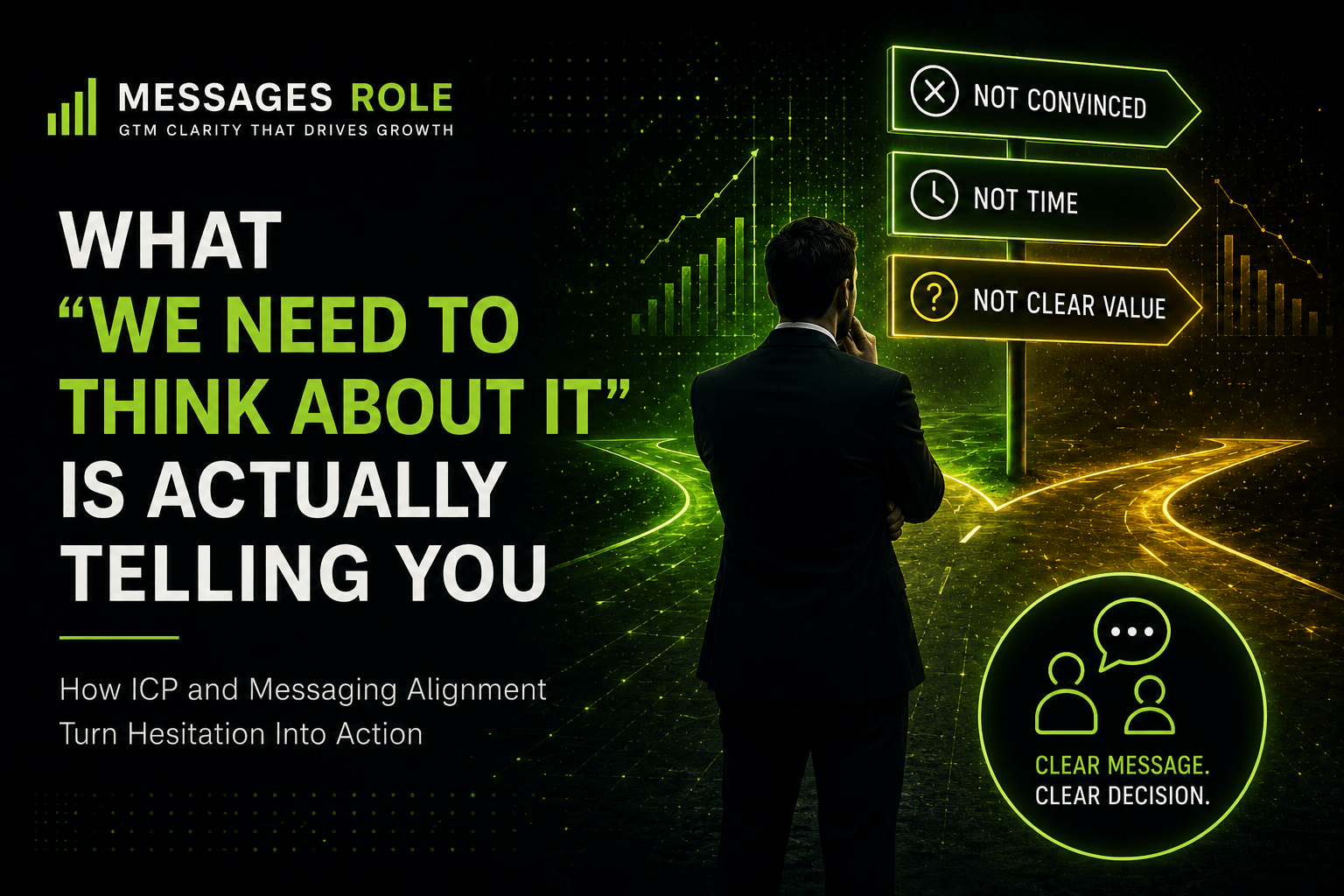
“We need to think about it” is not a timing problem. It is a messaging problem. The prospect is not asking for more time. They are telling you the value did not land clearly enough to justify internal action.
The product may be real. The problem may exist. But something in the conversation did not connect specifically enough to create urgency, and without urgency, nothing moves.
The Problem Usually Starts Upstream
I’ve seen this pattern repeatedly across early-stage companies, and the diagnosis is almost always upstream. By the time a prospect says they need to think about it, the conversation has already gone the wrong direction.
The issue usually starts with positioning that is too broad and an ICP that is not defined tightly enough to support specific messaging.
What This Looks Like in Practice
What this looks like in practice:
- Messaging that describes what the product does without connecting it to a business consequence the buyer is already feeling
- Differentiation that exists on the website but does not show up clearly in the conversation
- A prospect who understands the feature set but cannot articulate internally why it matters right now
That last one is the expensive version. A buyer who cannot make the internal case for your product is not going to move regardless of how good your follow-up sequence is.
Why Some Companies Convert More Consistently
The companies that convert consistently are not running a better sales process. They understand their buyers at a level specific enough to anticipate objections before they surface.
The conversation feels relevant immediately because the buyer recognizes their situation in the messaging. That recognition is what creates urgency. You cannot manufacture it through activity.
Where Companies Usually Get This Wrong
Where I’ve seen this break down most often is when a company interprets repeated hesitation as a sales execution problem and responds by adding volume.
- More outbound
- More demos
- More follow-up cadences
If the positioning is weak, more volume produces more of the same result at higher cost. The pipeline gets busier and conversion stays flat.
What Actually Fixes the Problem
The fix is not downstream. Tightening the ICP and sharpening the messaging changes the quality of every conversation that follows.
Discovery gets more productive. Buyers engage faster. Internal momentum builds earlier because the value is already framed in terms that make sense to the business.
The Better Question to Ask
When a deal stalls at “we need to think about it,” the question worth asking is not how to follow up better.
It is whether the right person heard a specific enough message about a problem they are already trying to solve.
If the answer to any part of that is no, the hesitation makes complete sense.
Stan Bowers has spent 19 years helping early-stage SaaS companies build pipeline and growth systems. The ICP and Messaging series covers the targeting and positioning decisions that determine whether a GTM motion converts or stalls.
 stanbowers.com