Most early-stage companies invest in demand generation channels that were designed for businesses that already have awareness. The economics do not translate, and the results reinforce the wrong hypothesis. The fix is not a better campaign. It is a different approach entirely.
When you have no brand presence, broad is the enemy. A wide-net strategy assumes some percentage of the market already knows enough about you to engage. They do not. Every dollar spent reaching people who have no context for who you are produces noise instead of pipeline.
Precision Before Scale
What actually works at the pre-awareness stage is precision. Find the segment where your product solves a specific problem better than anything else available, and go deep before you go wide. Not because it is a tactic, but because a tight segment is the only place you can build enough reference density to create momentum.
Three customers in the same vertical who will talk to each other are worth more than ten scattered wins across multiple industries.
Why Most Outbound Fails
Direct outreach is underrated at this stage, but most companies do it wrong. Generic sequences sent to a broad list produce generic results.
What actually works is a small, carefully researched list, a message that shows you understand the specific problem the recipient has right now, and a reason to respond that is not about your product. Leading with the product before the problem is understood is the fastest way to get ignored.
Borrowing Trust Through Partnerships
Partnerships are often the most efficient channel available to a company with no awareness, and one of the most underused. Find businesses that already have the trust of the buyers you want to reach and create a reason for them to engage with you.
A warm introduction from a trusted source does more for your pipeline than months of cold outreach. This is how early markets open when budget and brand are limited.
Content That Actually Works
Content works at this stage, but not in the way most companies approach it. Blog posts that require awareness to find and context to appreciate do not move the needle when you are starting from zero.
What works is content that functions as a tool. A guide, a diagnostic, a calculator. Something a buyer can use without knowing who you are. That is how attention is earned.
The Motion That Builds Momentum
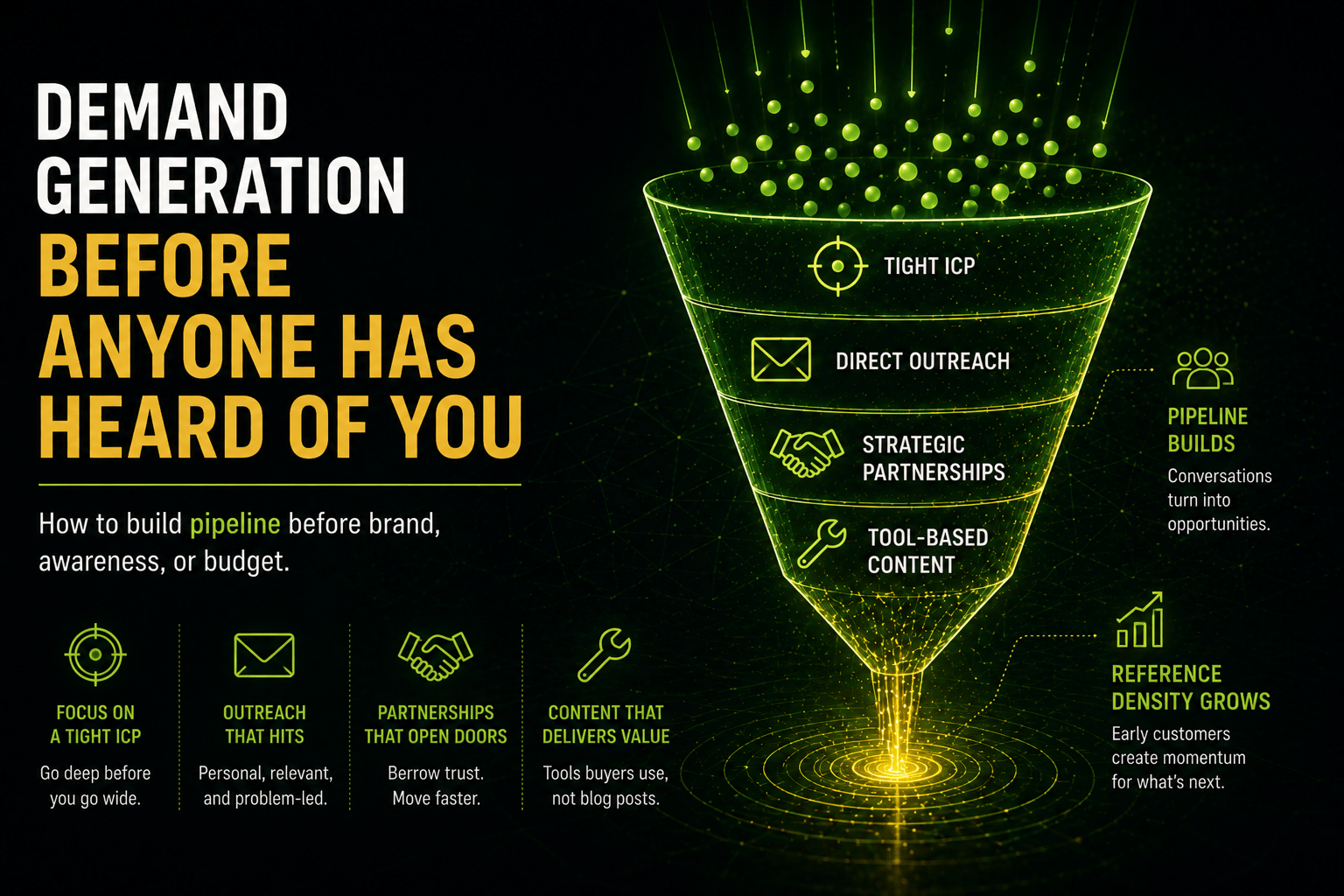
The sequencing that actually works is straightforward. Tight ICP. Direct outreach into that segment. One or two partnership channels that provide credibility. Tool-based content that gives buyers a reason to engage.
Run that motion with discipline for six to nine months and two things happen. Pipeline starts to build, and early customers begin to create the reference density that makes the next conversation easier.
The Reality Most Founders Miss
None of this is glamorous. It also does not require a brand budget you do not have.
What it does require is focus and discipline. Most companies abandon this motion too early because it does not produce immediate scale. They move back to broader channels before the initial segment has had time to compound.
What actually happens is the early signals get ignored. A few conversations turn into a few customers, but instead of doubling down, the company shifts direction. Momentum resets, and the process starts over.
The companies that get through this stage are the ones that stay with it long enough to let it work.
Stan Bowers has spent 19 years helping early-stage SaaS companies build pipeline and growth systems. This series covers the decisions that matter most in the first 12 to 24 months of building a marketing and revenue function.
 stanbowers.com