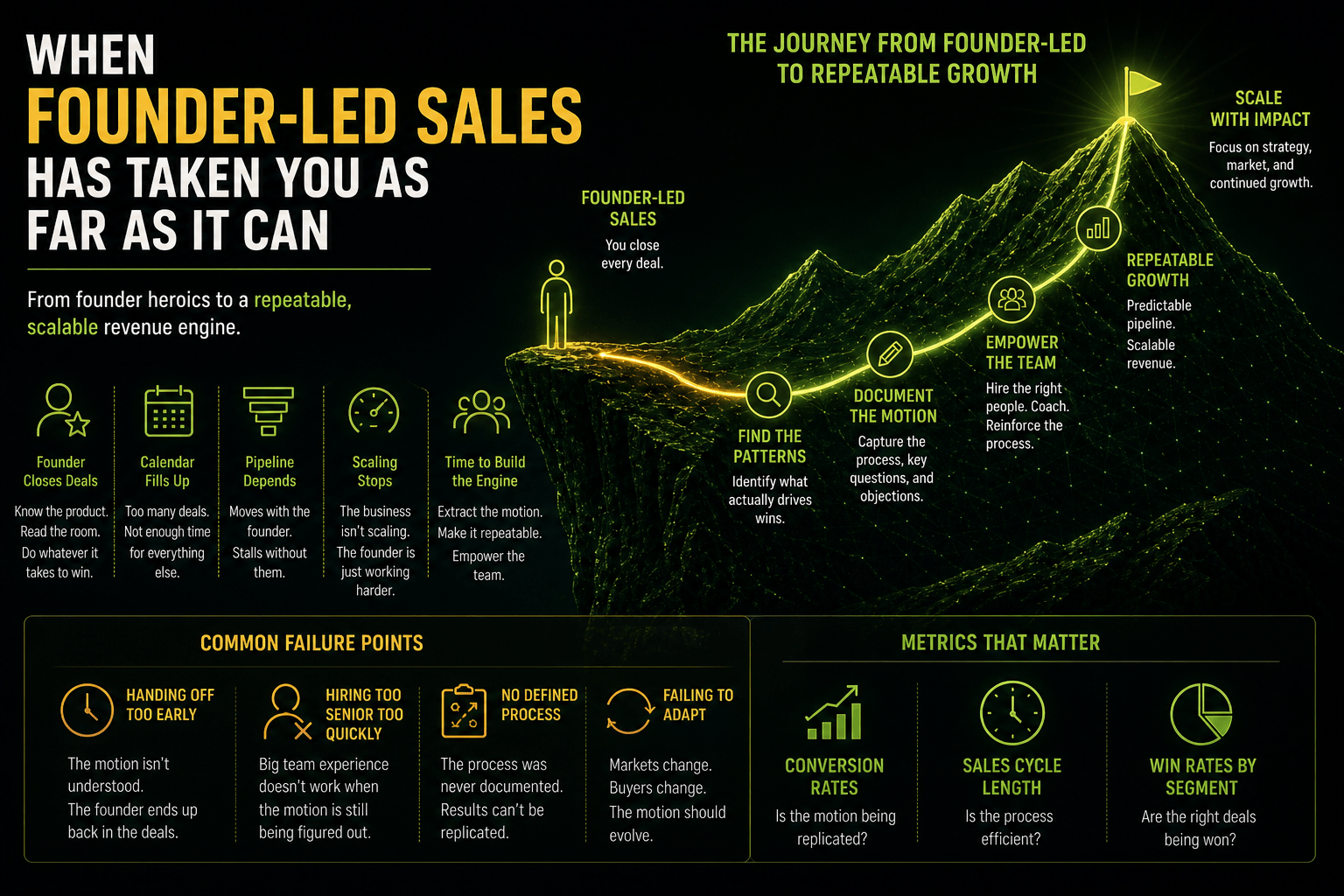
Founder-led sales works until it doesn’t. The founder closes deals because they know the product cold, they can read a room, and they are willing to do whatever it takes to get to yes. That is an advantage early on. It becomes a constraint the moment the company needs to do more than one thing at a time.
The signal is usually obvious in hindsight. The founder’s calendar fills with deals. Product decisions start getting made without the person who should be making them. Pipeline moves when the founder is involved and stalls when they are not. At that point the business is not scaling. It is just the founder working harder.
The Real Work Is Making It Repeatable
What actually needs to happen is not just hiring a sales team. It is extracting what the founder is doing in those conversations and making it repeatable. Most founders cannot clearly explain this. It is instinct built over time, and instinct does not transfer on its own.
You start to see patterns once you look for them. Certain types of companies close faster. The same objections come up repeatedly. The first ten minutes of a call often determine how the rest of the conversation goes. That knowledge exists, but it usually has not been made usable by anyone else yet.
Where the Transition Breaks Down
This is where things tend to break down. The founder hands off too early, before the motion is understood, and then ends up back in the deals when the team cannot replicate the results. It looks like a hiring issue, but it is usually a sequencing issue. The process was never actually defined.
The other failure point is hiring too senior too quickly. Someone used to managing a large team is not going to operate effectively in an environment where the motion is still being figured out. What is needed first is someone who can execute, learn, and help document what is actually working.
How the Founder’s Role Changes
Once the motion is clear and someone else can run it, the founder’s role changes. Not to disappearing from revenue, but to staying close enough to the market to keep the motion accurate. Buyers change, competitors shift, and messaging that worked before eventually stops working. The founder is usually the first to see that, if they stay engaged.
When Metrics Start to Matter
Metrics start to matter more at this stage, not because instinct stops working, but because it cannot scale across a team. Conversion rates, sales cycle length, and win rates by segment tell you whether the motion is being replicated or whether each person is doing something different.
The True Goal
The goal is not to remove the founder from revenue. It is to build something that does not depend on them being in every deal. There is a difference between staying close to the business and being the business. Most companies do not make that transition cleanly, and it is usually where growth starts to stall.
Stan Bowers has spent 19 years helping early-stage SaaS companies build pipeline and growth systems. This series covers the decisions that matter most in the first 12 to 24 months of building a marketing and revenue function.
 stanbowers.com