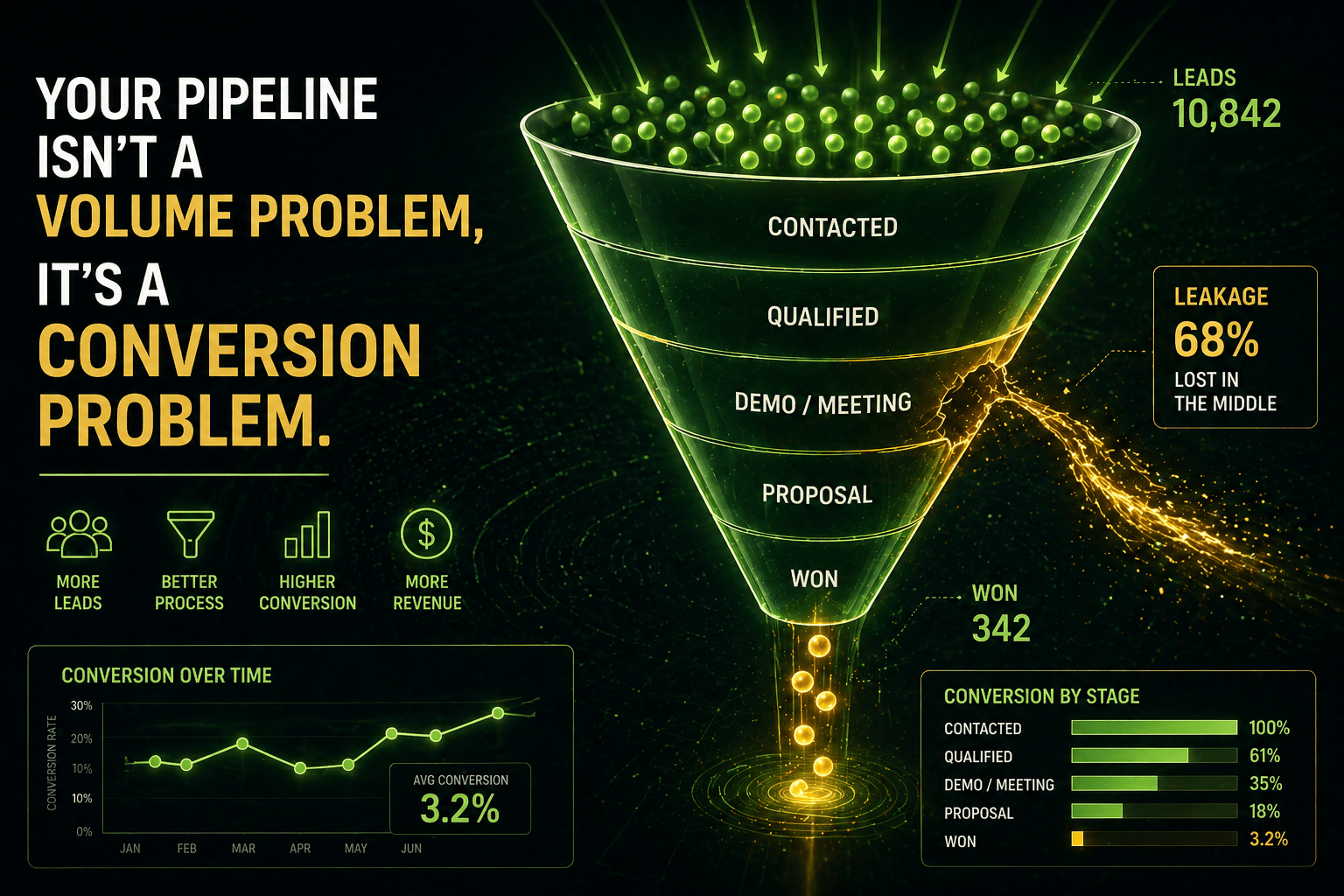
When pipeline stalls, the instinct is almost always the same: add more leads. More outbound sequences. More SDR activity. More top-of-funnel investment. More fuel.
The problem is that most early-stage SaaS companies don’t have a volume problem. They have a conversion problem. And pouring more leads into a broken funnel doesn’t fix the funnel. It just makes the inefficiency more expensive.
Before you spin up another outbound campaign or renegotiate your lead-gen contract, spend 30 minutes looking at what’s actually happening inside your pipeline. The answer is usually in there.
The volume trap and how founders fall into it
Adding pipeline volume feels like action. It’s concrete. You can measure it. You can report it to your board. “We increased outbound by 40% this quarter” sounds like progress.
But volume is also the easiest thing to reach for when you don’t know where the real problem is. It’s a way of betting that somewhere in the additional activity, something will shake loose.
Here’s the math that should give you pause: if you’re converting 15% of your discovery calls to qualified opportunities, adding more leads doesn’t change that 15%. You just get 15% of a bigger number, at a higher cost, with more noise in the system, and with a team that’s working harder for proportionally the same result.
The founders who break out of this cycle are the ones who stop asking “how do we get more leads?” and start asking “why aren’t the leads we have converting?”
Where to look first: the break point
Every pipeline has a stage where deals accumulate and die. Usually not gradually. There’s usually one transition where the drop-off is notably worse than the others. That’s your break point, and finding it is the most valuable diagnostic exercise you can run.
Pull your pipeline data and look at stage-by-stage conversion rates across the last two quarters. You’re looking for the step where the percentage drop is disproportionate relative to the others.
Common patterns in early-stage SaaS:
Discovery to qualified opportunity. High drop-off here usually means an ICP problem. You’re getting conversations with people who will never buy, either because the problem isn’t painful enough, the budget doesn’t exist, or they were never the right fit to begin with. More leads makes this worse, not better. The fix is tighter targeting before the conversation ever starts.
Qualified opportunity to proposal. Drop-off here is often a champion problem. Someone internally liked what they heard, but there’s no one with enough authority or motivation to move the evaluation forward. Your champion can’t sell internally, so the deal sits. The fix is qualifying harder for internal buy-in during discovery, not just for budget and need.
Proposal to close. This is where “we need to think about it” goes to live forever. Drop-off at this stage almost always means one of three things: the economic buyer was never actually involved, the value case wasn’t specific enough to justify action, or the timing is wrong and no one said so out loud. The fix requires examining how you’re running late-stage deals, not how many proposals you’re sending.
The difference between a stuck stage and a broken one
Not all drop-off is the same. Some stages are slow because deals are genuinely complex and decision cycles are long. Others are slow because something is structurally broken in how you’re running that part of the process.
The test is replication: can you identify the deals in that stage that are moving, understand why they’re moving, and apply that logic to the ones that aren’t? If yes, and you’re simply not doing it, that’s a process gap. If you can’t explain why some deals progress and others don’t, that’s a structural problem.
Structural problems include things like:
- No defined criteria for what moves a deal from one stage to the next, which means stages are based on optimism rather than evidence
- Discovery calls that gather information but don’t establish urgency or test fit rigorously
- Proposals that describe the product instead of articulating a specific outcome for that specific buyer
- Follow-up that is activity-based (“I sent the email”) rather than outcome-based (“I confirmed the next step and who owns it”)
None of these get better with more volume. They get more expensive.
Velocity matters as much as conversion rate
Even if your stage-to-stage conversion rates look acceptable, your pipeline can still be broken. It’s just broken in a different way. Look at how long deals are sitting in each stage.
Average deal age by stage is one of the most honest signals in pipeline health. A deal that’s been sitting in “proposal sent” for 60 days in a product with a typical 30-day sales cycle isn’t a live deal. It’s a deal you haven’t closed out yet.
Founders often resist aging out stale pipeline because it makes the number look smaller. It also makes it look more accurate, which is the only version of the number that’s actually useful.
When you remove deals that are statistically unlikely to close and focus on what’s actually moving, two things happen. First, you get a more honest read on where you are. Second, you force a real conversation about what’s causing the stall, which is the conversation that leads to the fix.
The question that reframes everything
Here is a question worth asking about every stalled deal in your pipeline: if this deal is going to close, who on the buyer’s side is actively working to make that happen?
If you can’t name a person and describe something specific they are doing, the deal isn’t in motion. It’s in your CRM. Those are different things.
The companies that consistently hit their numbers are not the ones with the most pipeline. They’re the ones where the pipeline they have is real, where there’s mutual movement, where next steps are defined and owned, and where deals that aren’t moving get called out and addressed instead of carried forward on hope.
That discipline doesn’t come from adding leads. It comes from understanding your conversion motion well enough to know when something is working, when it isn’t, and why.
Where to start this week
If your pipeline isn’t converting at the rate you need, don’t adjust your outbound volume before you’ve done this:
Map your stage-by-stage conversion rates for the last 90 days. Find the worst one. Ask why it’s worse than the others. Talk to two or three people on your team who have direct contact with deals at that stage. They usually know what’s broken. They’re often not asked.
What you find will almost certainly be more actionable than whatever you would have done with more leads.
Stan Bowers has spent 19 years helping early-stage SaaS companies build pipeline and growth systems. This series covers the decisions that matter most in the first 12 to 24 months of building a marketing and revenue function.
 stanbowers.com